Classifier-Free Diffusion Guidance
NeurIPS Workshop(2021), 937 citation
한 줄 요약
Condition을 일정 확률로 null로 바꿔 하나의 모델이 conditional·unconditional score를 함께 학습하게 하고, 두 예측을 \(w\)로 조합해 별도의 classifier 없이 guidance를 준다.
"Guidance without Additional Classifier"
| 흐름 | 내용 |
|---|---|
| 문제 | Classifier guidance는 noisy image & time step을 입력으로 받는 별도의 classifier model을 추가로 학습해야 한다 |
| 아이디어 | $\nabla_x \log{p(y |
| 결과 | 하나의 model로 conditional과 unconditional model을 동시에 학습하고, \(w\)로 FID와 IS 사이의 trade-off를 조절 |
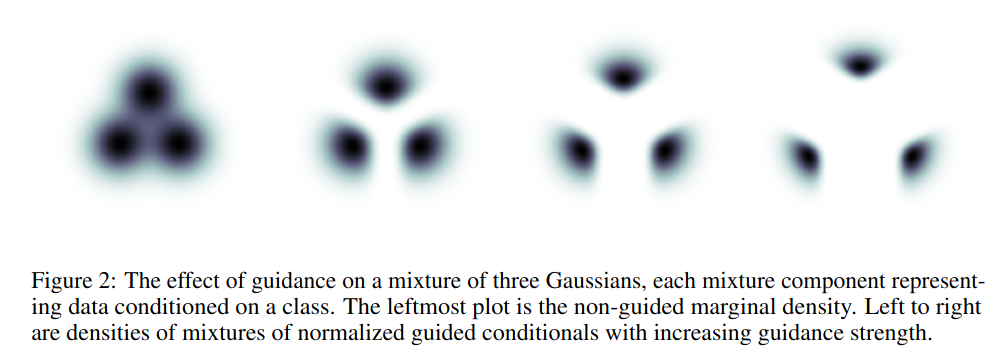
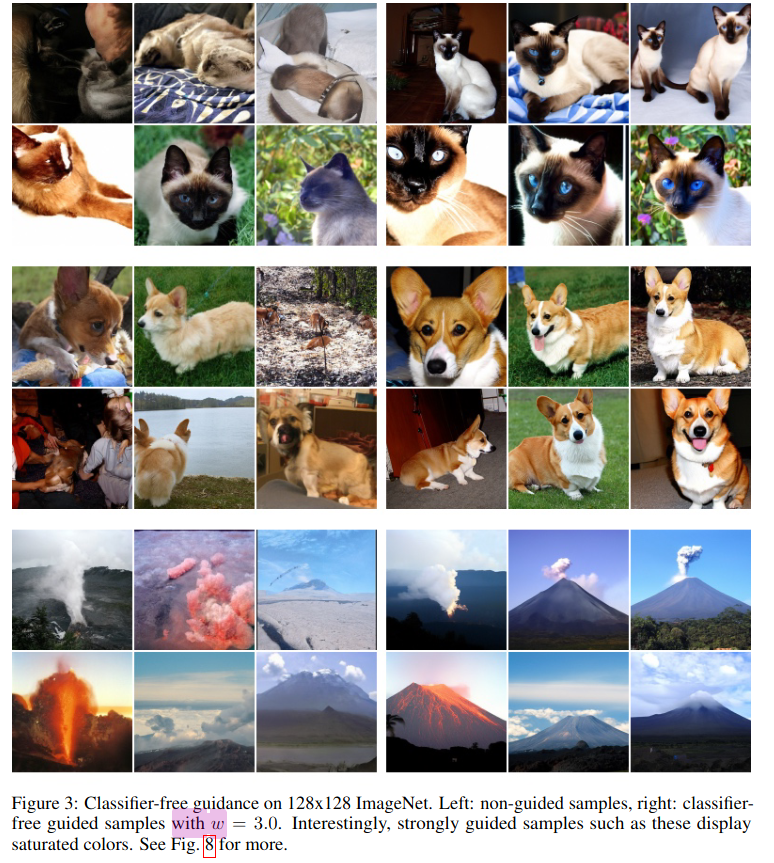
Figure 1. Classifier-free guidance 결과
1. 방법
- 다음의 식을 이용한다. reference
\[ \nabla_x \log{p_{\sigma_i}(x)} \approx s_\theta^{*}(x_t,t\ or \ \sigma) = - \frac{1}{\sqrt{1-\bar\alpha_t}}\epsilon_\theta(x_t, t\ or \ \sigma) \]
- Condition \(y\) 를 given 으로 \(y\) 를 반영해서 이미지를 생성하고 싶다면 다음과 같이 식이 전개된다.(\(\sigma\) 생략)
\[ \nabla_x \log{p(x_t|y)} = \nabla_x \log{\frac{p(x_t)p(y|x_t)}{p(y)}} \]
\[ = \nabla_x \log{p(x_t)} + \nabla_x \log{p(y|x_t)} - \nabla_x \log{p(y)} \]
- \(x\) 에 관한 함수가 아닌, \(\nabla_x \log{p(y)}\) 는 소거된다.
\[ \nabla_x \log{p(x_t|y)} = \nabla_x \log{p(x_t)} + \nabla_x \log{p(y|x_t)} \]
- \(\nabla_x \log{p(x_t)}\) 을 좌항으로 넘기면, 다음과 같이 만들어진다.
\[ \nabla_x \log{p(x_t|y)} - \nabla_x \log{p(x_t)} = \nabla_x \log{p(y|x_t)} \]
- 위의 수식을 Classifier guidance 의 수식인 \(\gamma\nabla_x \log{p(y|x_t)}\) 에 대입하게 되면, reference
\[ \nabla_x \log{p(x_t|y)} = \nabla_x \log{p(x_t)} + \gamma\nabla_x \log{p(y|x_t)} \]
\[ \nabla_x \log{p(x_t|y)} = \nabla_x \log{p(x_t)} + \gamma(\nabla_x \log{p(x_t|y)} - \nabla_x \log{p(x_t)})\]
\[ = \gamma\nabla_x \log{p(x_t|y)} + (1-\gamma)\nabla_x \log{p(x_t)} \]
- 우측 항에 존재하는 텀들은 모두 model(parameter) 로 근사하는 값이기에 \(\theta^*\) 를 찾으면 식이 동일하게 된다.
- 하지만, \(\theta^*\) 는 찾기가 어려우므로 결국 우측 항에 있는 텀들은 좌측 항으로 넘길 수 없게 되고
- \(1-\gamma = -w\) 로 치환하게 되면, \(\gamma = 1+w\) 이므로,
\[ (1+w)\nabla_x \log{p(x_t|y)} + (-w)\nabla_x \log{p(x_t)} \]
\[ = (1+w)\epsilon_\theta(x_t, c) - w\epsilon_\theta(x_t) \]
Important
Classifier-free guidance
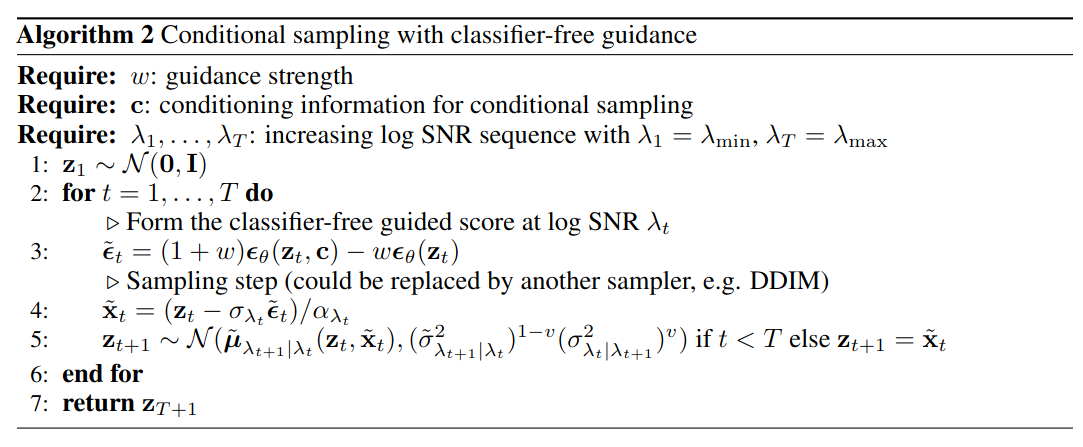
\[ \therefore \tilde{\epsilon_\theta}(x_t, c) = (1+w)\epsilon_\theta(x_t, c) - w\epsilon_\theta(x_t) \]
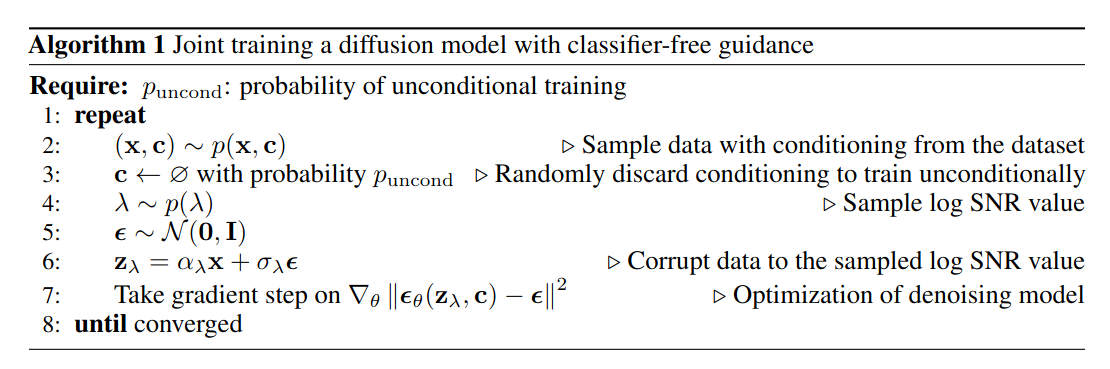
- 따라서, conditional score model 을 학습 시키되 \(p_{uncond}\) 의 확률로 condition 에 \(null\) 값을 주면서 학습시키면 \(\epsilon_\theta(x_t, c), \epsilon_\theta(x_t)\) 을 동시에 구할 수 있게 된다.
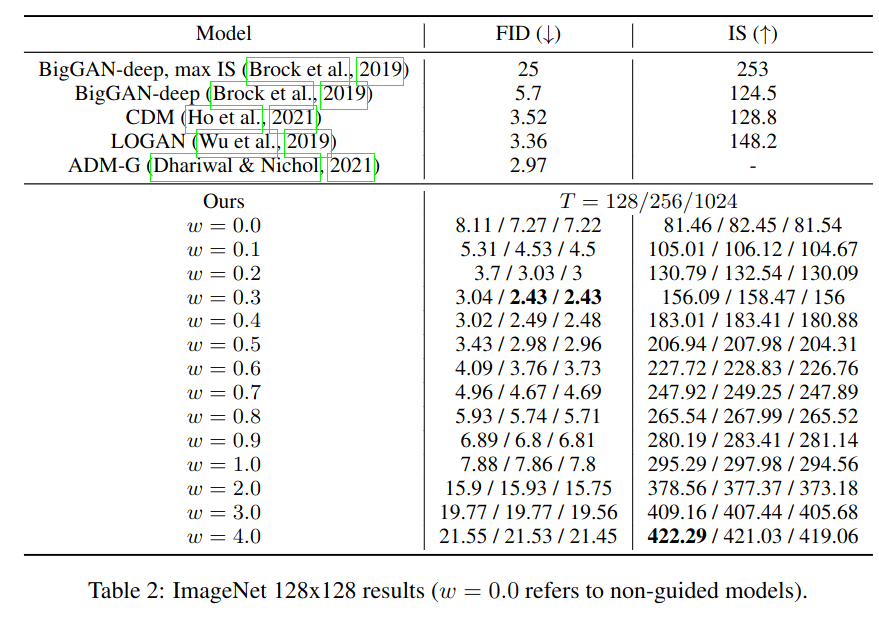
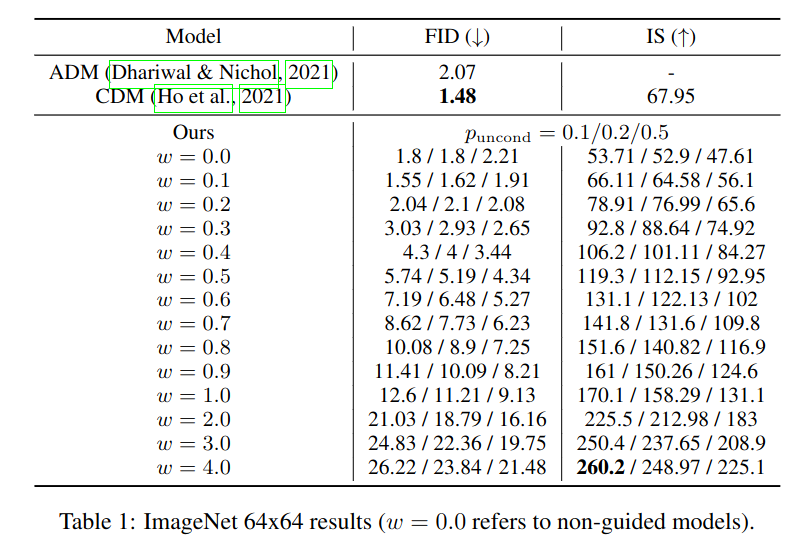
- \(w\) 는 조절 가능한 가중치이다. 논문에서는 \(w=0.1\) or \(0.3\) 일때 best FID result 를 얻었다고 한다.
- IS 의 경우, \(w >= 4\), 즉 trade-off 관계이다.
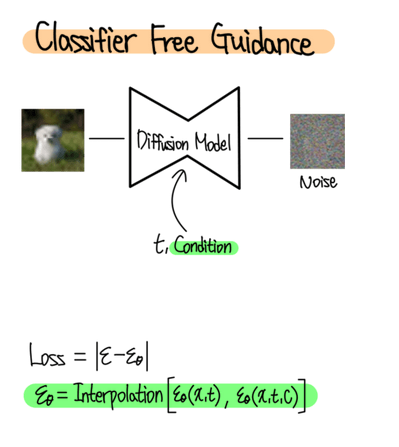
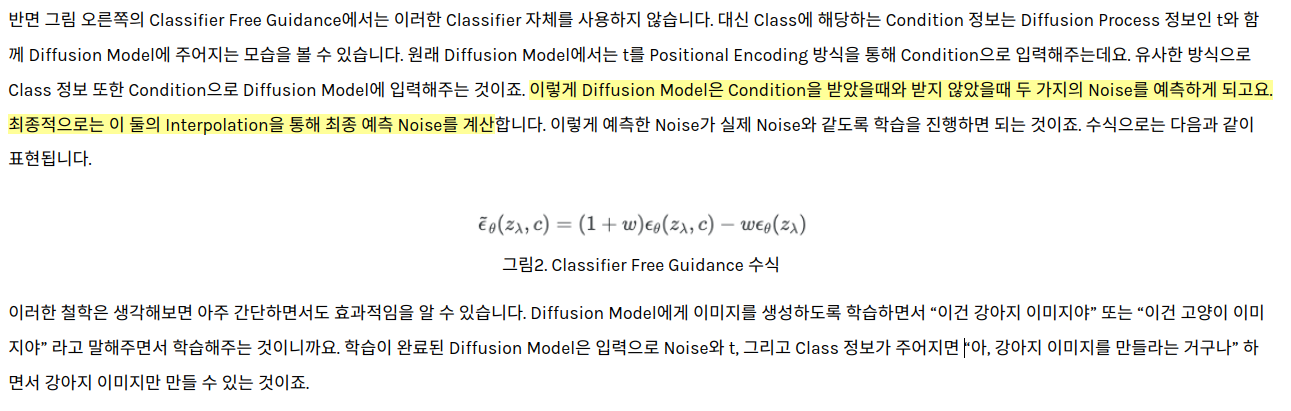

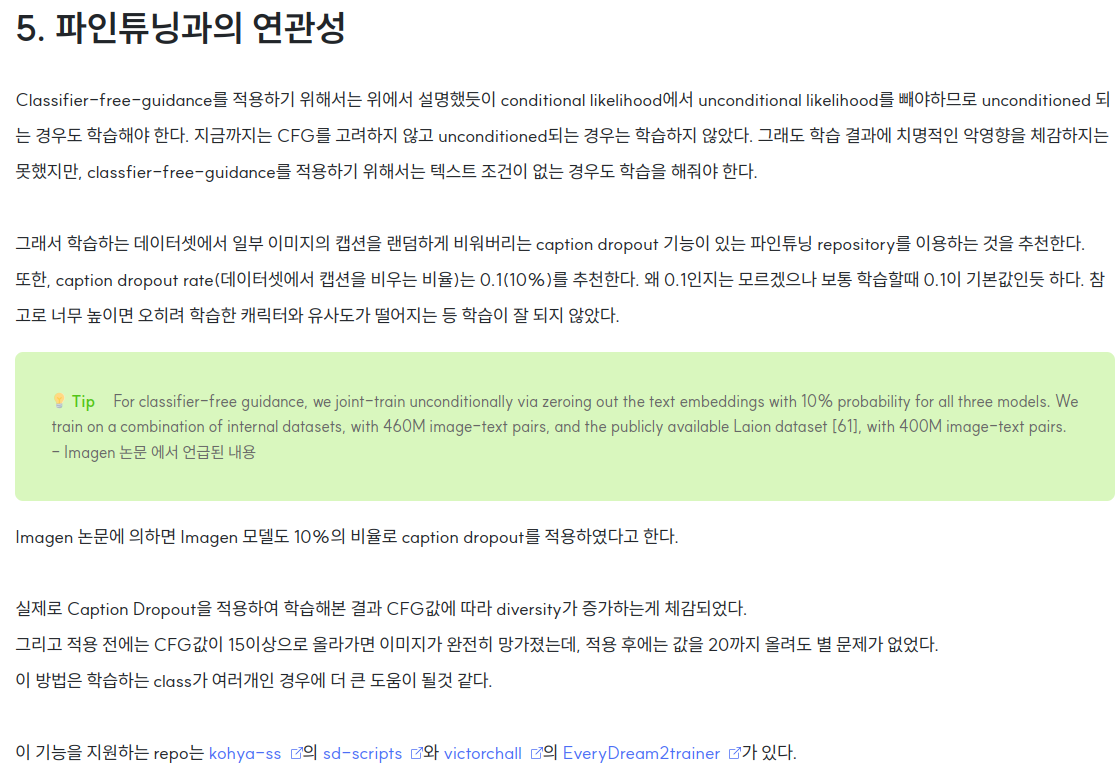
- 결론적으로, 하나의 모델을 사용하되 unconditional model 의 경우 null token 을 조건 \(c\) 로 주게 된다.

- 학습을 할때의 algorithm. DDPM 에서, condition \(c\) 를 넣는 것과 \(p_uncond\) 의 확률로 condition \(c\) 를 null 로만 바꿔주는 code 를 추가해주면 된다.
- Sampling algorithm
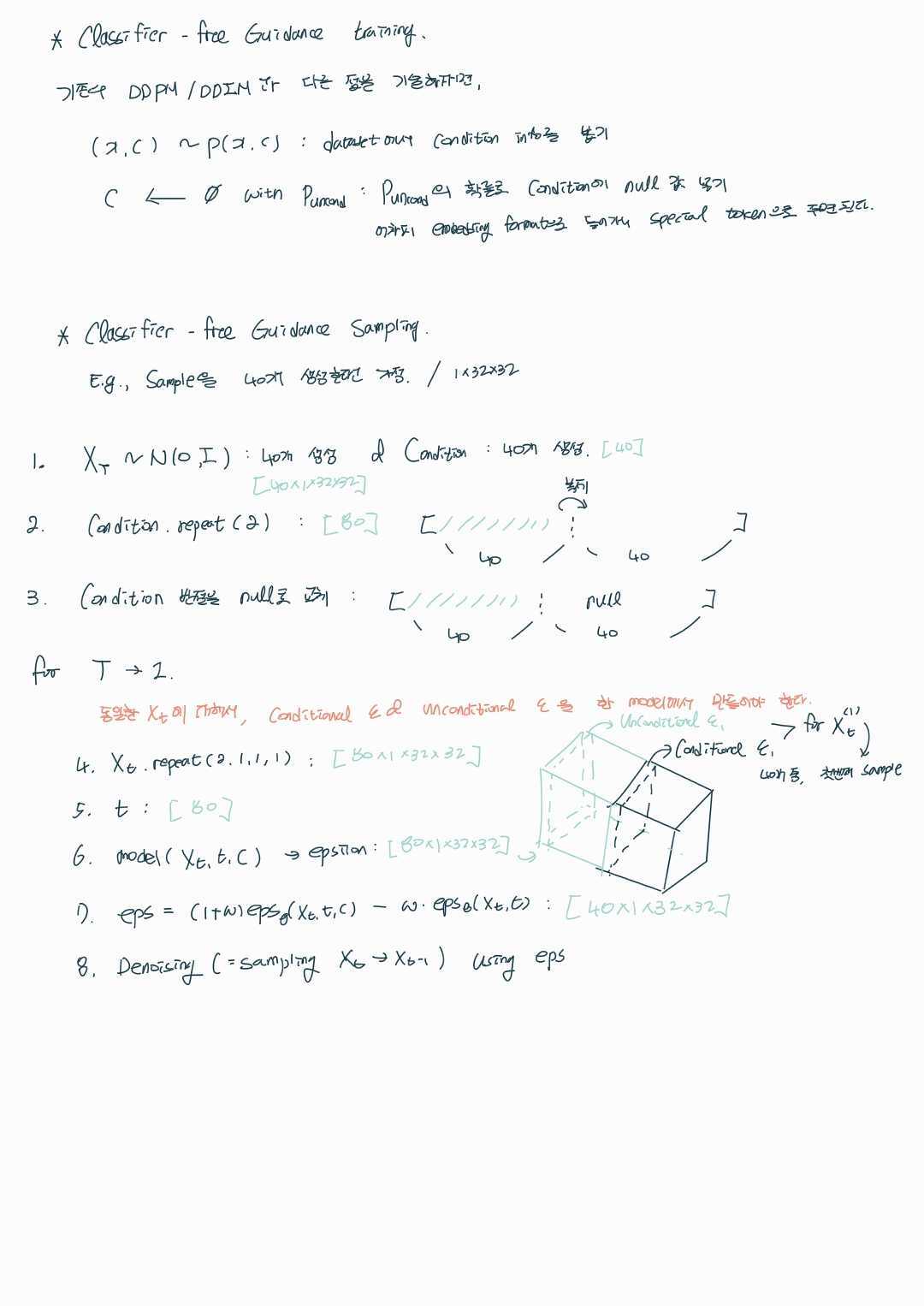
- Summarization
- 중요하게 봐야 될 건, Conditional 과 Unconditional 을 조합할 때, 같은 noisy input 을 입력으로 받아서 \(\epsilon\) 을 prediction 했다는 것이다.
2. 실험
3. 정리
- 하나의 model 로 conditional model 과 unconditional model 을 동시에 학습시킬 수 있는 방법이다.
- 이 기법은 추후에 Latent Diffusion Model 에서도 사용된다.
참고
- Paper · Code · 관련 리뷰: Classifier Guidance, LDM