Your Large Vision-Language Model Only Needs A Few Attention Heads For Visual Grounding
CVPR(2025), 9 citation, Yonsei University, Review Data: 2025.10.01
한 줄 요약
학습 없이, frozen LVLM의 수천 개 attention head 중 attention sum과 spatial entropy로 고른 단 3개의 localization head만으로 visual grounding(REC/RES)을 수행한다.
| 흐름 | 내용 |
|---|---|
| 문제 | LVLM 기반 visual grounding은 bounding box나 segmentation mask를 만들기 위해 fine-tuning이나 추가 model component가 필요하고, LVLM의 text-to-image attention map은 sparse하고 noise가 많다 |
| 아이디어 | Last text token query와 image token 사이의 attention에서 attention sum과 spatial entropy 두 기준으로 text semantics에 맞는 object를 포착하는 localization head를 찾고, top-3 head의 map을 Gaussian smoothing · 합산 · binarize해 pseudo mask(→ bounding box, SAM prompt)로 사용 |
| 결과 | 기존 training-free method를 크게 넘고, REC에서는 Shikra · Ferret, RES에서는 LISA 같은 fine-tuned LVLM과 비교할 만한 성능 |
"Propose training-free LVLM framework to perform visual grounding task using a few attention heads"
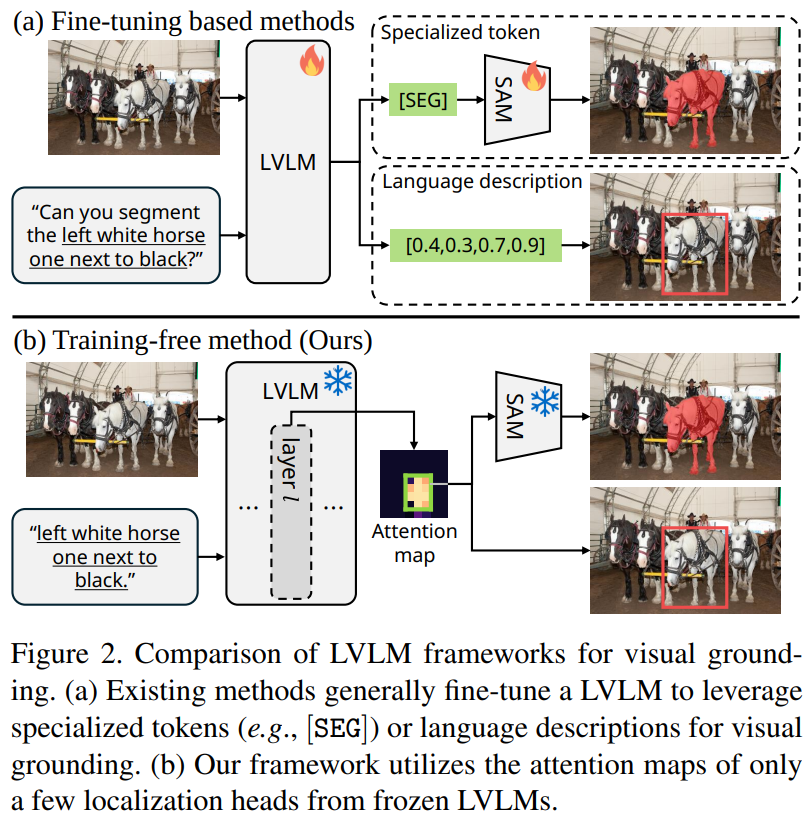
Figure 1. 기존 fine-tuning 기반 방법과 localization head를 이용한 training-free framework 비교
1. 문제 정의 — 왜 이 논문이 필요한가
배경.
- Visual grounding: localize the image region corresponding to a free-form text description.
-
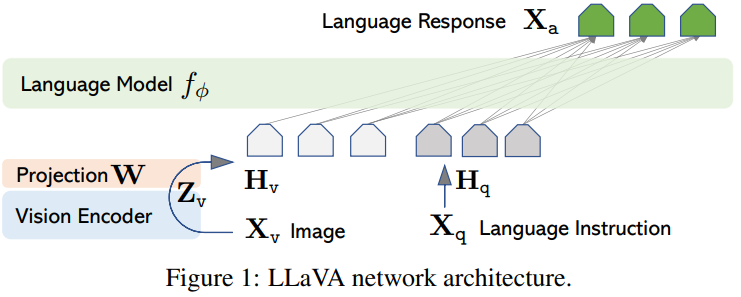
Large Vision-Language Models (LVLMs): 다음의 세 가지 주요 구성요소로 이루어진다.
- 시각 인코더: 이미지를 분석하여 시각 토큰으로 변환
- 어댑터: 시각 토큰을 LLM이 이해할 수 있는 언어 토큰 형식으로 변환
- LLM: 어댑터를 통해 전달된 시각적 토큰과 기존의 텍스트 입력 토큰을 결합하여 입력받아, 텍스트를 생성한다.
-
LVLM 중 하나인 LLaVA model
기존 방법의 한계.
-
Large Vision-Language Models (LVLMs)의 강력한 multimodal capabilities로 인해 visual grounding의 엄청난 발전이 있었지만, 필연적으로 명시적인 bounding box나 segmentation mask를 생성하기 위해 모델을 fine-tuning하거나 추가적인 model components를 필요로 한다.
-
기존의 ViT나 diffusion model은 관련된 text와 관련된 영역을 포착한다는 것을 쉽게 예상할 수 있다.
- 하지만, ViT나 DMs에서 관찰된 해석가능한 attention pattern과는 달리 LVLMs에서의 text-to-image attention map에서는 sparse하고 significant noise를 함유하고 있다.
-
TS CAM (ViT)
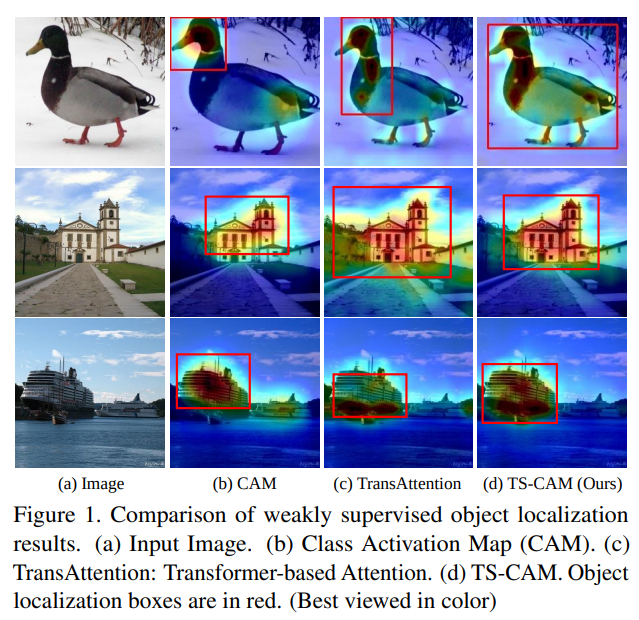
- DAAM (DM)
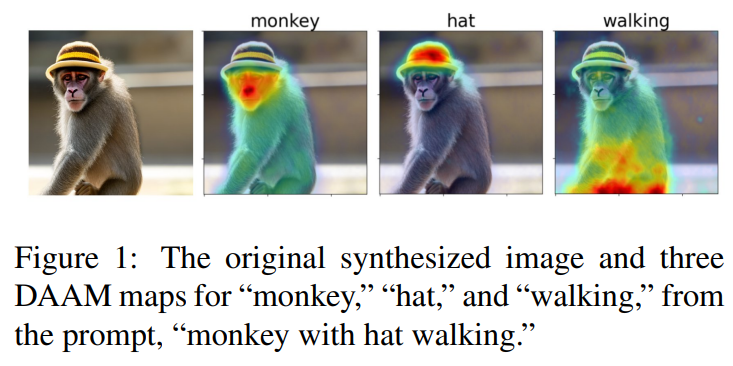
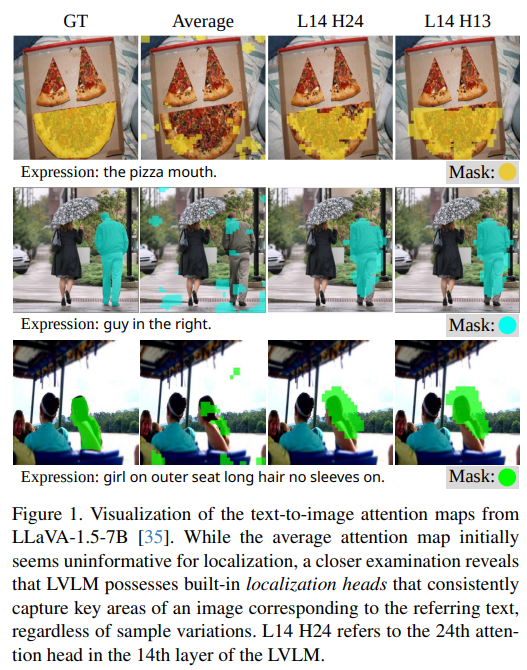
- 이는 최신의 LVLM attention map이 정확하게 visual grounding에 대해 관련있는 객체를 포함하는 게 어렵다는 걸 의미한다. (Second column in below Figure)
이 논문의 접근.
-
하지만, average가 아닌 일부 attention head의 small subset이 정확한 text-image attention map을 제공가능하단는 것을 보여준다. (Third, Fourth column)
-
본 저자들은 a few attention heads in frozen LVLMs가 강력한 visual grounding capabilities를 가지고 있음을 발견했다.
- 일관되게 text semantics와 관련된 object location을 capture하는 이러한 head들을 본 논문에서는 localization head로 부른다.
- 이 localization head를 이용하여 직관적이고 효율적인 training-free visual grounding framework를 제안한다.
-
놀랍게도, 수천 개의 attention head 중 단 \(3\) 개 만으로 경쟁력 있는 localization performance를 달성하기에 충분하다.
- 이는, 기존의 fine-tuning이 필요한 LVLM-based visual grounding의 성능과의 비교이다.
-
기존의 fine-tuning based method와 비교하여, 본 논문의 training-free framework가 추가적인 fine-tuning의 필요성을 제거하고 있음을 보여준다.
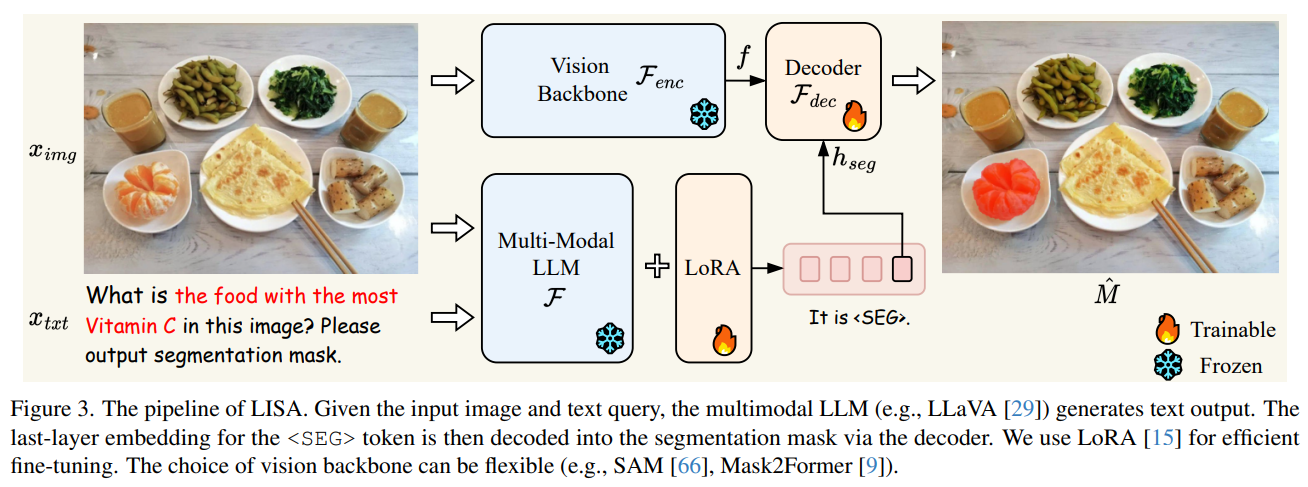
- 기존의 fine-tuning based method: LISA ([SEG] token을 사용하여 SAM에게 전달하는 방식)
2. 사전 지식
- Visual Grounding
- Aims to identify the region in image based on a free-form natural language expression.
- Referring Expression Comprehension (REC)와 Referring Expression Segmentation (RES)로 나눌 수가 있다.
- REC: localizing a referred object in an image and generating a bounding box
- RES: pixel-level segmentation mask
- Referring Expression Comprehension (REC)와 Referring Expression Segmentation (RES)로 나눌 수가 있다.
- Aims to identify the region in image based on a free-form natural language expression.
- Application of LVLMs in Grounding Tasks
- LVLM의 뛰어난 vision-language processing capabilities를 활용하여 visual grounding에서의 상당한 발전을 이뤘다.
- LVLM을 visual grounding task에 통합시키기 위해, training process에서 visual grounding dataset을 포함시키거나, localization information을 추출하기 위해 추가적인 components를 구현한다.
- LISA: [SEG] token을 mask embedding으로 도입하고 additional mask decoder를 사용하여 segmentation mask를 생성한다.
- F-LMM: frozen LVLMs의 attention weights를 이용하는데, 여전히 visual grounding dataset에서의 mask refinement module에 대한 학습이 필요하다.
- 반면에 우리는 LVLMs을 바로 이용할 수 있는 training-free visual grounding method를 제안한다.
- Training-Free Visual Grounding
- 다양한 vision-language task들서 multimodal foundation model들의 높은 성능이 주어졌을 때, training-free visual grounding은 새로운 연구 방향으로 주어진다.
- 기존의 training-free method는 일반적으로 internal feature or attention maps from CLIP or DMs를 적용한다.
- 본 논문은 최초의 LVLM 기반 훈련 없는 visual grounding framework를 도입함으로써 이 연구 분야를 발전시켰다.
3. 방법
3.1 Notation
- LVLMS은 일반적으로 \(3\)개의 main components로 구성된다: vision encoder, projector, large language model
- Image \(X_v\)는 vision encoder와 projector를 거쳐서 visual embedding \(Z_v \in \mathbb{R}^{P^2 \times d}\).
- \(P^2\): number of flattened image tokens
- \(d\): hidden dimensions
- Text \(X_t\)는 token embedding \(Z_t \in \mathbb{R}^{L\times d}\)가 된다.
- \(L\): number of tokens in the text
- The visual and textual embeddings are concatenated as \(Z_0 = [Z_v; Z_t] \in \mathbb{R}^{(P^2 + L) \times d}\) and fed into the large language model (LLM)
3.2 Multi-Head Self-Attention
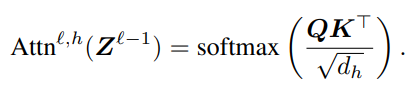
- \(Z_0\)는 LLM의 input으로 들어간다. (decoder blocks: multi-head self-attention and feed-forward)
- In layer \(l\) and head \(h\),
3.3 Investigation of Image-Text Interaction
- LLM decoding이 auto-regressive manner로 동작하는 걸 고려하면 final token의 정보는 전체 문장의 context를 담고 있다.
- 따라서 last input text token \(q_{txt}\)는 문장 전체를 대표하는 쿼리로 작동한다고 본다.
- E.g., 아래 그림에서 "the pizza mouth."에서의 "."이 last token의 query vector로 사용된다.
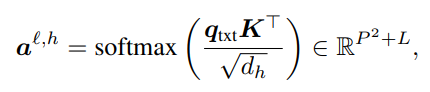
- Image-text interaction을 조사하기 위해, 저자들은 key 중에서 image token과, query 중에서 \(q_{txt}\) 간의 attention weight를 확인한다.
- 구체적으로, 위의 attention 수식을 수정하여 다음과 같이 표현한다.
- 본 논문에서는 앞의 \(P^2\) components에 대해서 집중한다: \(a^{l,h}[1:P^2]\)
- 즉 text token \(q_{txt}\)과 각 image token과의 연관성을 확인한다.
- Self attention에서 내가 원하는 component들끼리의 연관성만을 확인하는 것.
3.4 Discovering Localization Heads
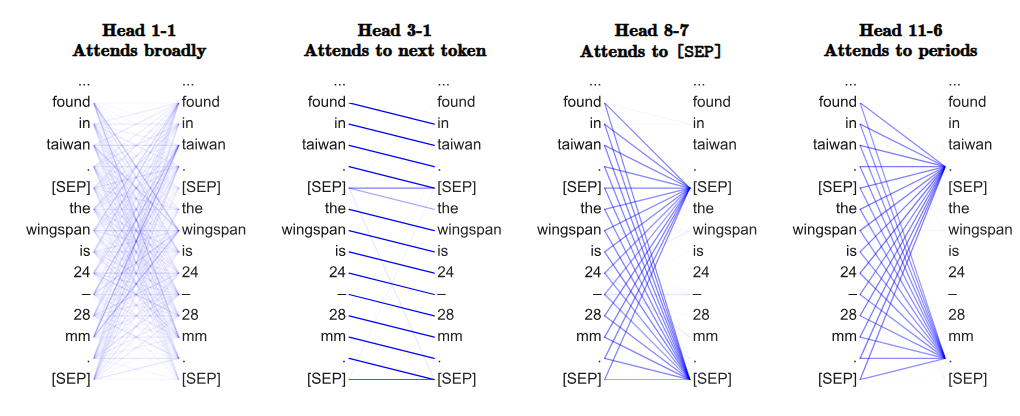
- 최근 연구 에서는 attention head가 구별되는 특징을 가지고 있고 특정 head가 text와 관련있는 localizer로써 제공될 가능성을 보여줬다.
- \(2\)가지 기준으로 이러한 head를 선택한다: sum and spatial entropy
- 제안된 기준으로 텍스트 설명과 대응되는 객체를 포착하는 헤드를 성공적으로 식별할 수 있음을 검증한다.
- 특히, LLM의 초기 \(2\)개의 layer는 다른 layer들과는 다르게 동작하는 것으로 알려져 있어, 본 논문의 분석에서는 일관되게 제외된다.
- 다양한 LVLMs와 데이터셋을 대상으로 실험을 수행한다.
Attention Sum
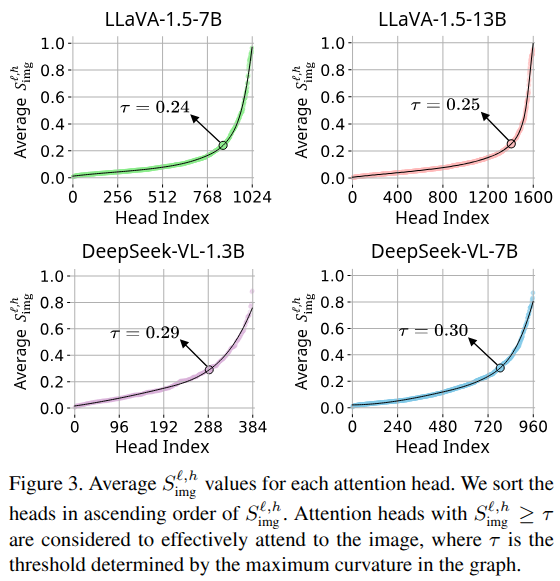
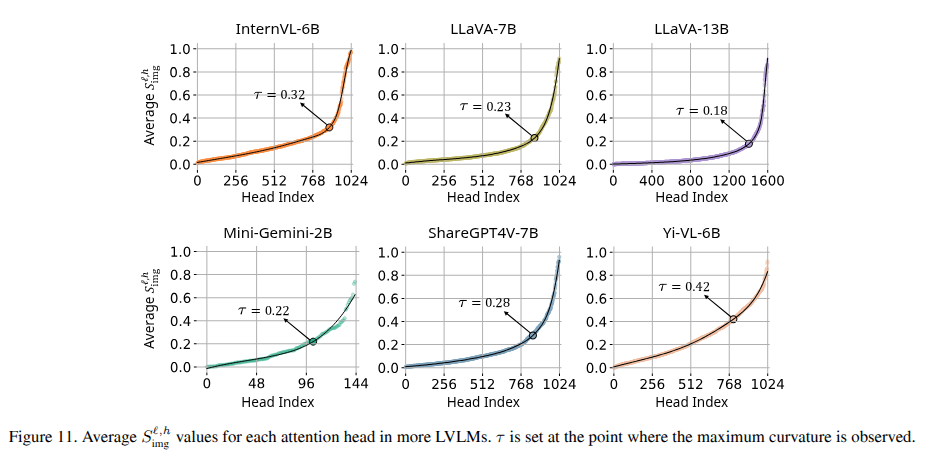
- 주로 전체 이미지에 집중하는 attention head를 식별하기 위해, 먼저 각 attention head 내에서 이미지 정보가 \(q_{text}\)와 얼마나 관련성 있는지를 정량화한다.
- RefCOCO training set에서 \(1,000\) 개의 이미지를 랜덤으로 sampling하고 \(1,000\) 장에 대해서 각각의 \(S_{img}^{l,h}\) 값을 평균낸다.
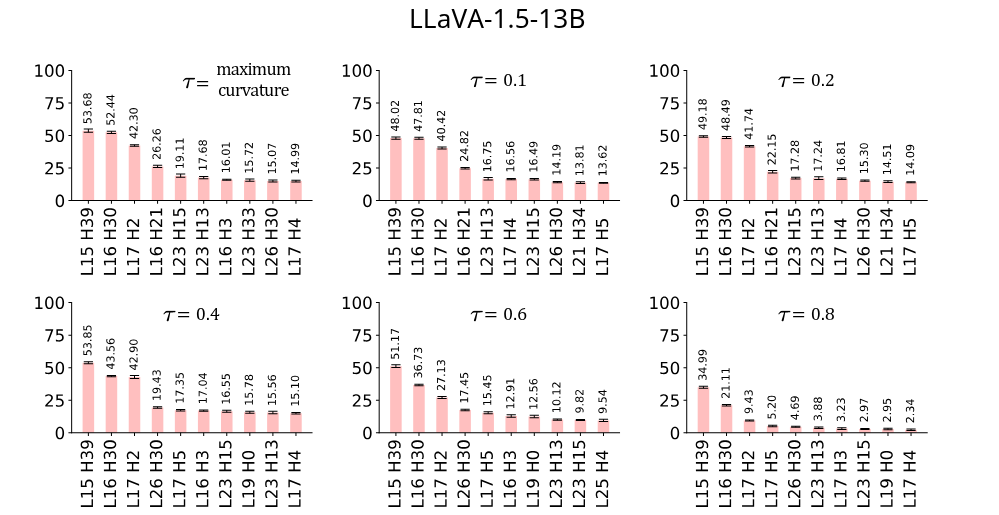
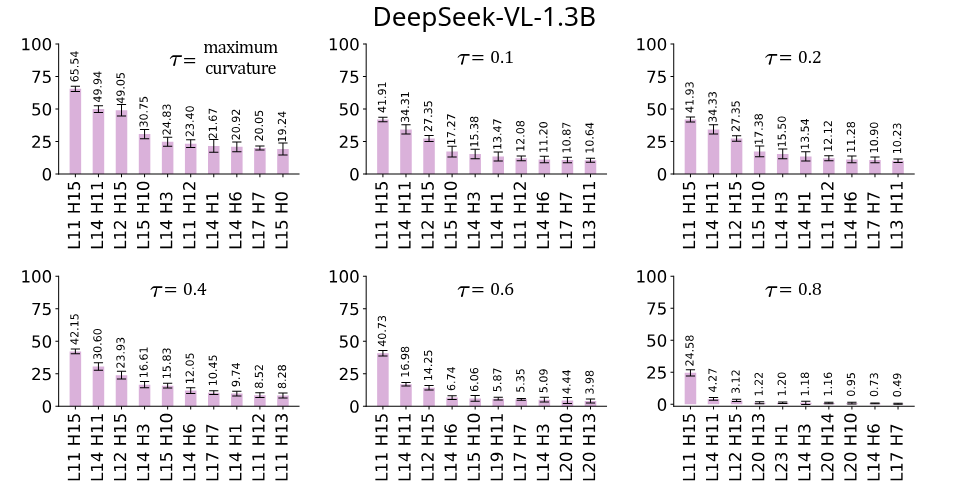
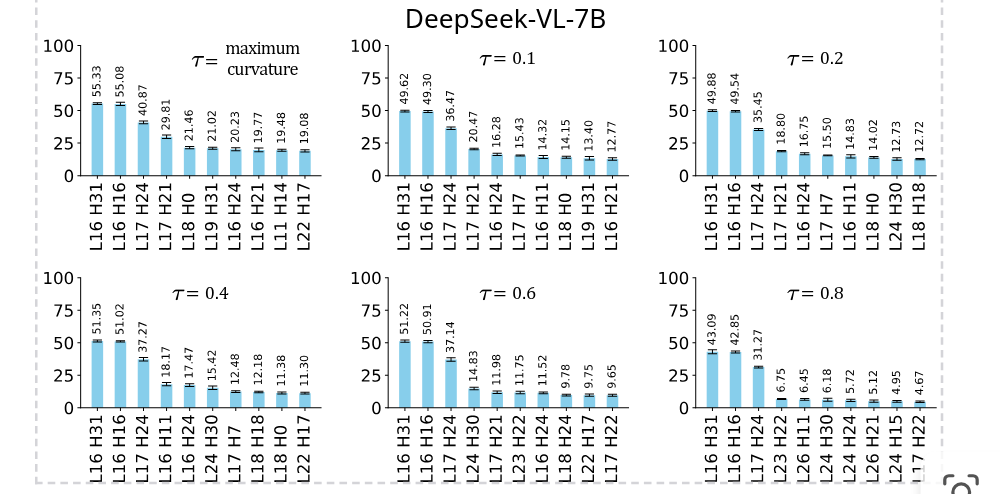
- Graph상에서 곡률이 가장 큰 값을 threshold로 설정한다. (\(\tau\))
- 대부분의 heads가 low \(S_{img}^{l,h}\) 값을 보이고, 이는 상대적으로 적은 head만이 text-image interaction에 상당한 영향을 준다는 것을 의미한다.
- 본 논문은 threshold를 설정하여 그 값보다 높은 head가 효율적으로 text-image interaction에 참여한다고 간주한다.
- Threshold에 대한 실험
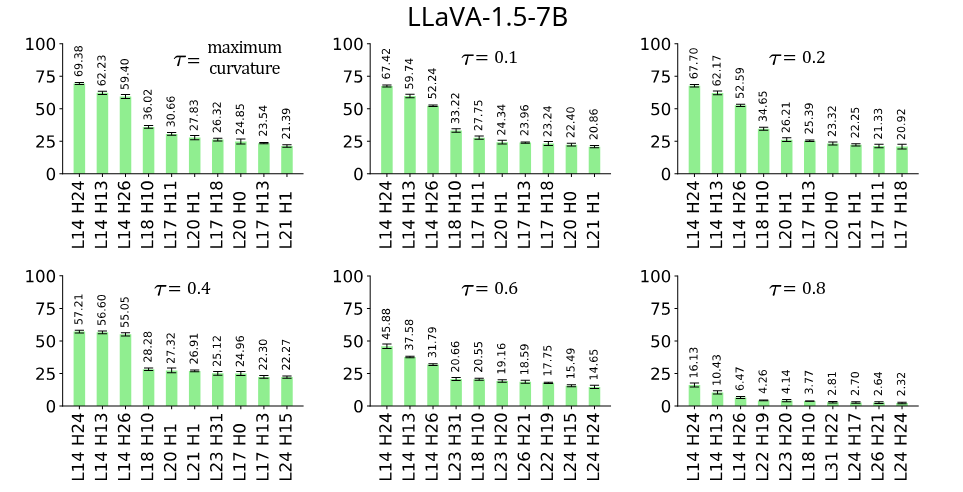
- Adaptive하게 설정하는 것이 아닌 고정된상수 값으로 top-3 localization head를 선정했을 때의 성능을 보여준다.
- 본 논문에서 설정한 maximum curvature가 다양한 모델에 대해서 robust하다는 것을 보여준다.
Spatial Entropy H
- Attention sum을 통해 전체 이미지와 text token \(p_{text}\) 와 관계가 있는 head들을 선정할 수 있었다.
- Object에 효과적으로 focusing하는 head들을 고려하기 위해선, 그 head들은 image에 대해 high attention sum을 가져야 할 뿐더러, object 주변에 구체적으로 집중해야한다.
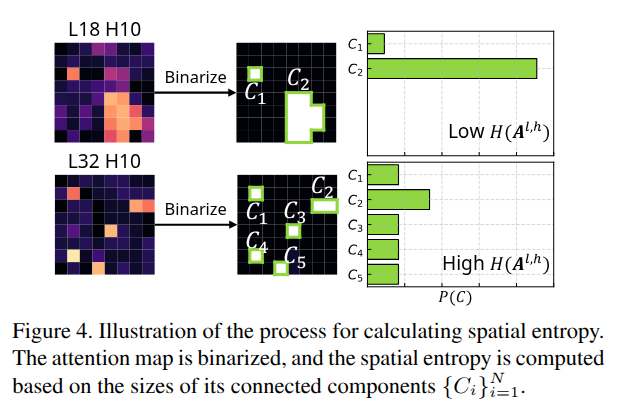
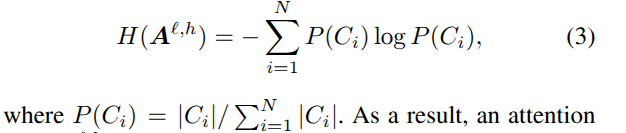
- Localization head를 구별하기 위해 각 attention map에서 얼마나 지역적으로 cluster를 형성하는지를 spatial entropy로 평가한다.
- Attention weight \(a^{l,h}[1:P^2]\)를 attention map \(A^{l,h} \in \mathbb{R}^{P \times P}\)로 reshape한다. 이는 이미지의 공간적인 정보를 유지하는 형태이다.
- 이후, attention map을 binarize하는데 map의 평균보다 높은 값은 \(1\), 반대는 \(0\)이다.
- 각 8-neighbors로 cluster \(C_i\)를 구성한다. (주변에 \(1\)인 attention weight가 있으면 연결)

3.5 Finding Localization Heads via Criteria
- 위에서 정의한 \(2\)가지 기준으로 text와 연관된 object를 효율적으로 포착하는 head를 선정해야 한다.
- 먼저 RefCOCO training dataset \(1000\)장으로 Attention Sum의 threshold를 구하고, 그 값을 넘는 head들을 선정한다.
- 이후, 선정된 head들에 대해서 spatial entropy를 구하여 10-lowest spatial entropy head를 구한다.
- 이를 \(1,000\)장에 대해서 수행하여, 그 빈도수를 체크한다.
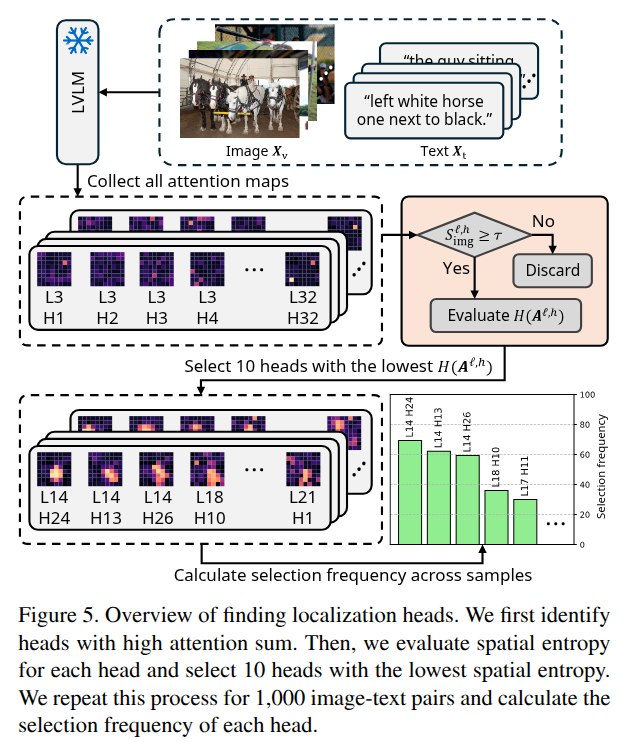
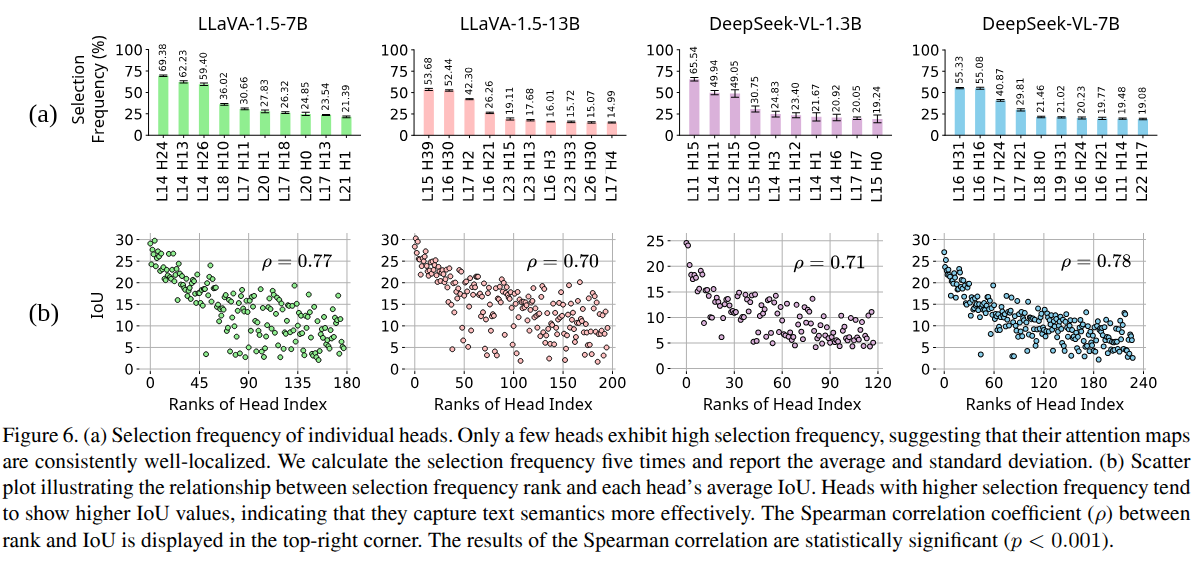
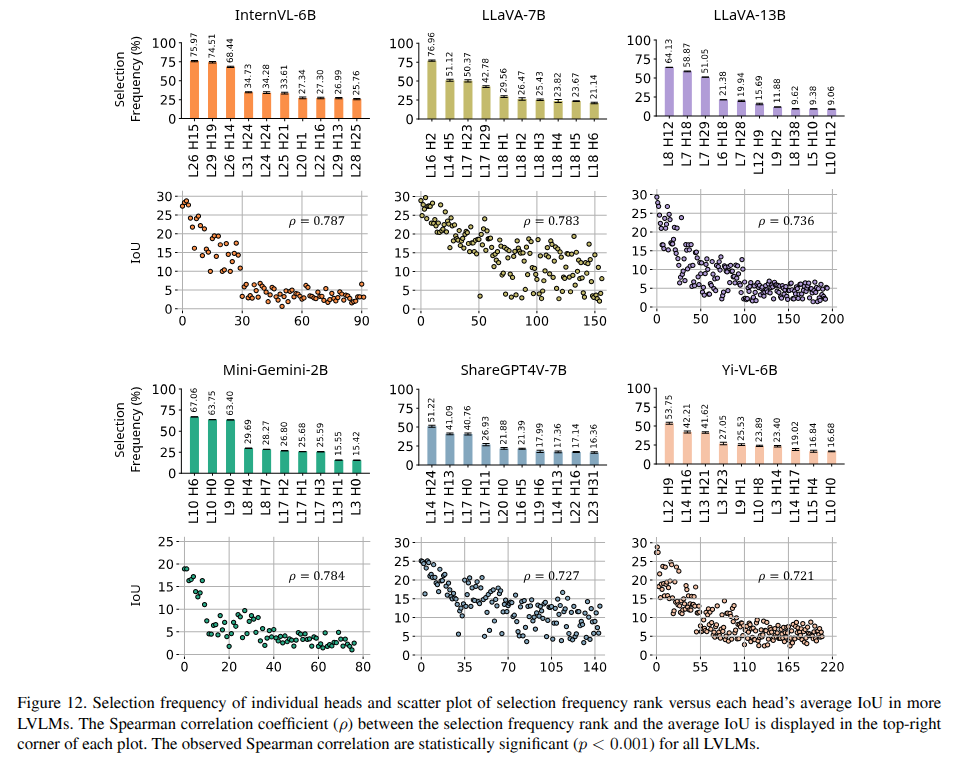
- 그렇게 최종적으로 선별된 head들의 selection frequency를 (a)에서 보여준다.
- (b): rank별로 나열해서 그 head들이 포착하는 region을 pseudo mask로 표현하여 GT mask와 IoU를 계산한다. 이는 selection frequency로 선정된 head들이 실제 text semantic를 효과적으로 잘 포착하는 것과 연결된다.
- 이 semantic information을 강하게 포착하는 a small number of top-ranked head들을 이제 localization head라고 지칭한다.
- 본 논문에서는 이 경향성이 다양한 LVLMs에 대해서 나타나는 것을 관찰하고 이를 LVLMs의 고유한 특성이라고 주장한다.
- 이는 Appendix의 있는 다양한 LVLMs에서 "이미지와 연관있는 head를 sum으로 선정 \(\rightarrow\) 그 중에서도 특정 object와 연관되는 head를 spatial entropy로 선정 \(\rightarrow\) 이 \(2\)가지 기준으로 선정된 top-ranked head들은 text semantic와 연관이 있다" 의 경향성을 다양한 모델에 대해서 검증했다.
3.6 Visual Grounding with Localization Heads
-
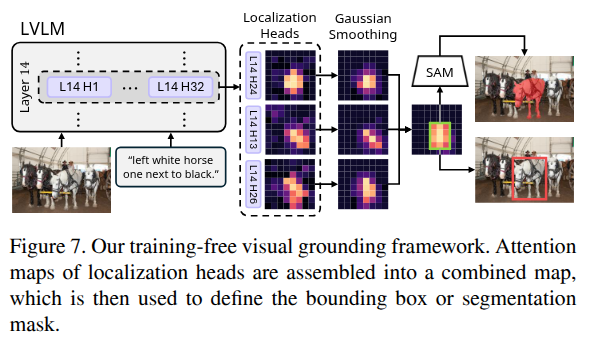
지금까지, \(2\) 가지 기준으로 text와 연관된 localization head를 식별했다. 이를 바탕으로, localization heads를 사용하여 visual grounding task를 수행하는 간단하지만 효과적인 방법을 제시한다.
- 본 논문에서는 localization head를 \(3\)개로 고정했다.
-
각 localization head에 대해서 potential random noise를 최소화하기 위해 Gaussian smoothing을 적용한다. 이후,element-wise summation & binarized 로 최종적으로 map을 완성한다.
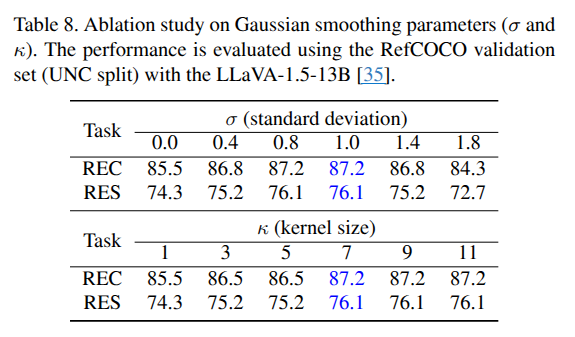
- Gaussian smoothing kernel size \(k=7\), standard deviation \(\sigma=1.0\)
- 이는 pseudo-mask로 간주하여 bounding box로 사용할 수 있고, 이를 SAM의 prompt로 제공하여 segmentation task를 수행할 수도 있다.
- Pseudo mask를 결정할때에는 convex hull algorithm을 사용했다.
- Gaussian smoothing ablation study
- Gaussian smoothing은 대부분의 경우에서 일관적으로 성능을 향상시킨다.
4. 실험
- Eval: Referring Expression Comprehension (REC) & Referring Expression Segmentation (RES)
-
Dataset: RefCOCO, RefCOCO+, RefCOCOg and more challenging scenario (ReasonSeg)
- ReasonSeg: requires complex reasoning or world knowledge
- For REC task, using Acc@0.5 metric
-
REC and RES task
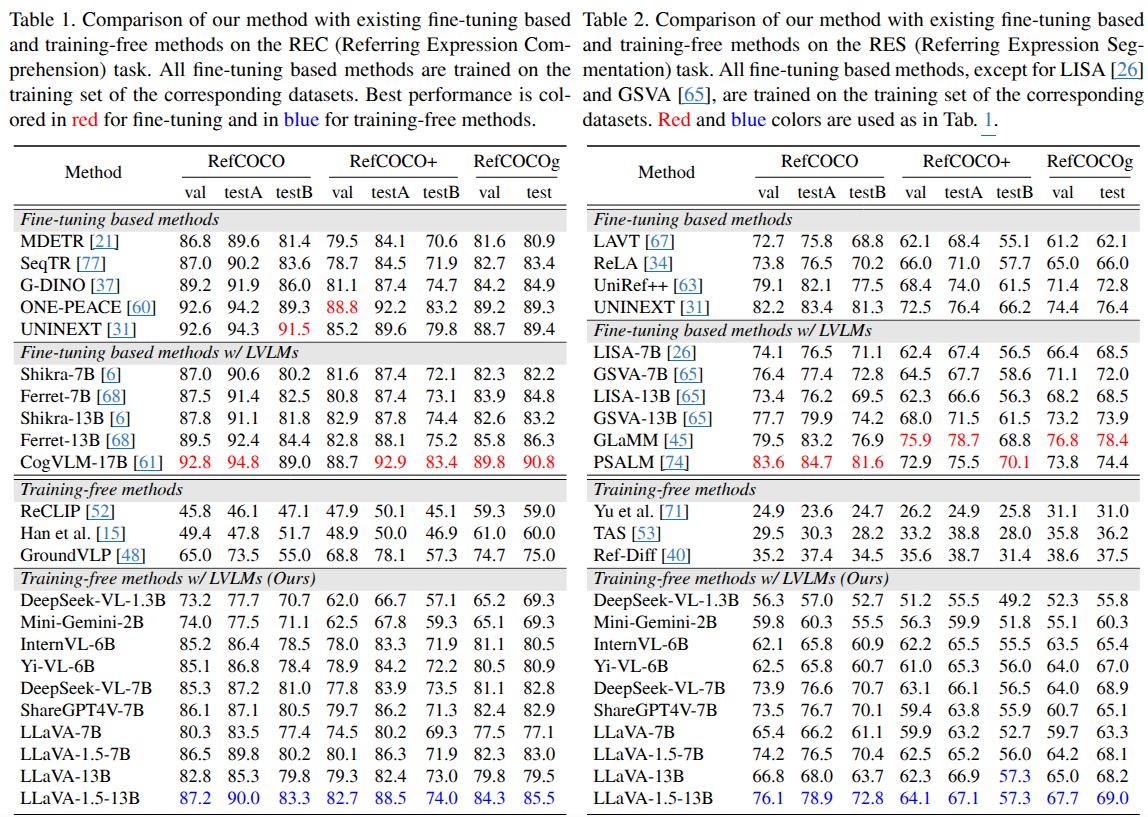
- 본 논문의 방법이 기존의 training-free method를 넘는 뛰어난 향상을 보였다.
- 놀랍게도, fine-tuned LVLMs와도 비교할만큼의 성능을 달성했다.
- REC task에 대해서는 Shikra와 Ferret와 동등한 성능을 달성한다. 같은 LLMs인 LLaVA 1.5를 사용함에도 fine-tuning based method와 동일하다.
- 비슷하게, RES task에서는 LISA와 동일하다.
- Visual grounding capability는 놀랍게도 1) 모델 크기가 커지거나, 2) 구조적으로나 training data의 발전이 있으면 향상된다.
- 1.3B to 13B
- LLaVA to LLaVA-1.4
- 이 관찰은 LVLM의 grounding ability이 larger model과 more diverse training data로 더 향상될 수 있음을 보여준다.
- 정성적 결과
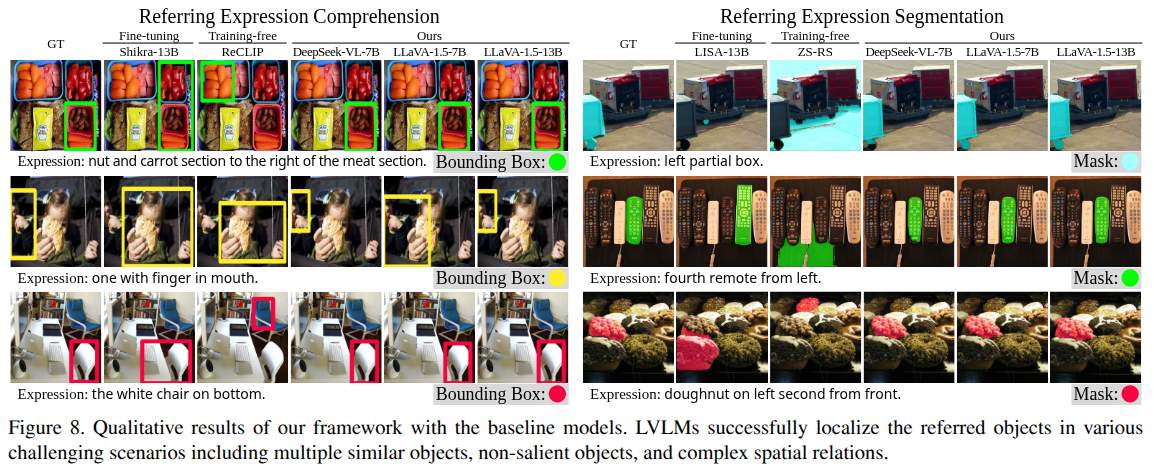
Ablation studies
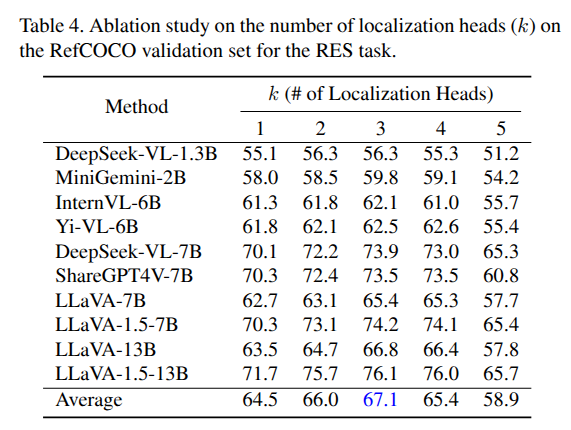
- Number of localization heads
- 모든 실험에서 localization head를 \(3\)개로 고정했었다.
- \(1 \rightarrow 3\): 성능이 일반적으로 향상된다. 이는 top-3 heads가 더 정확한 localization을 제공하기위해 서로 보완한다는 걸 의미한다.
- 하지만 더 증가하면 더 나은 성능을 보장하지 못한다. 이는 추가적인 헤드가 noise를 도입하거나 중복된다는 걸 보여준다.
- 최적의 \(k=3\)이 다양한 LVLMs에 대해 일관되게 유지된다는 점에 주목할 필요가 있다.
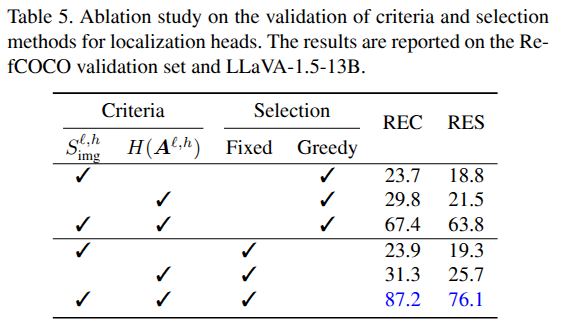
- Validation of Criteria and Selection methods for localization heads
- \(2\) 가지 기준으로 헤드를 선정했었는데, 이에 대한 검증이다. 각 기준으로 heads를 filtering (criteria)하고 최종적으로 selection을 하는데, 이때 Greedy의 경우 training data \(1,000\) 개에 대해서 frequency selection을 하지 않고 한 sample에 대해 filtering된 head를 바로 localization으로 사용하는 것이다.
Limitation
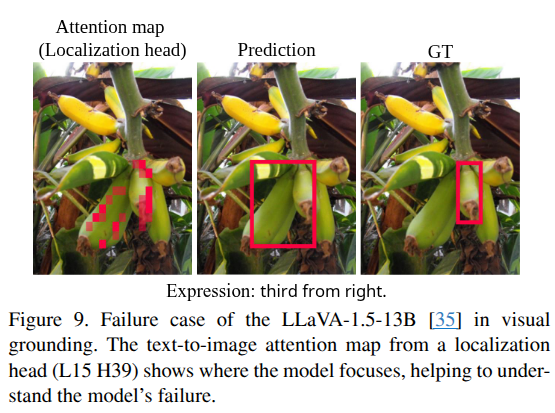
- 정확한 물체를 파악하는데 실패한 사례를 보여준다.
- 오른쪽에서부터 세 번째 바나나를 식별해야 하는데 localization head는 세 번째와 네 번째 바나나들을 focusing하고 있다. 이는 정확한 물체의 위치를 파악하는데 LVLMs이 어려움을 겪고 있음을 시사한다. 이러한 결과를 통해, LVLM이 이 어디에 집중하는지를 투명하게 이해할 수 있게 해주는 localization head의 잠재력을 보여준다.