SR3: Image Super-Resolution via Iterative Refinement
TPAMI(2022), 666 citation
한 줄 요약
Low-resolution image를 condition으로 concat한 conditional DDPM으로 pure Gaussian noise에서 iterative refinement를 수행해, 사람이 보기에 현실적인 super-resolution을 한다.
| 흐름 | 내용 |
|---|---|
| 문제 | Super-resolution의 \(p(y \mid x)\)는 one-to-many mapping이라, MSE/regression loss 기반 방법으로는 하나의 source에 대응하는 여러 target을 다루기 어렵다 |
| 아이디어 | Bicubic upsample한 low-resolution image \(x\)를 noisy image \(y_t\)와 concat하고 \(\bar\alpha_t\)를 함께 넣어 noise를 예측하는 conditional DDPM (U-Net, stochastic iterative refinement) |
| 결과 | CelebA-HQ \(8\times\) face SR에서 fool rate \(50\%\) (GAN baselines \(34\%\)), ImageNet \(4\times\) SR에서 human eval·ResNet-50 classification accuracy 능가, cascaded generation으로 \(256 \times 256\) ImageNet에서 경쟁력 있는 FID |
Core Idea: "Super-Resolution via DDPM"
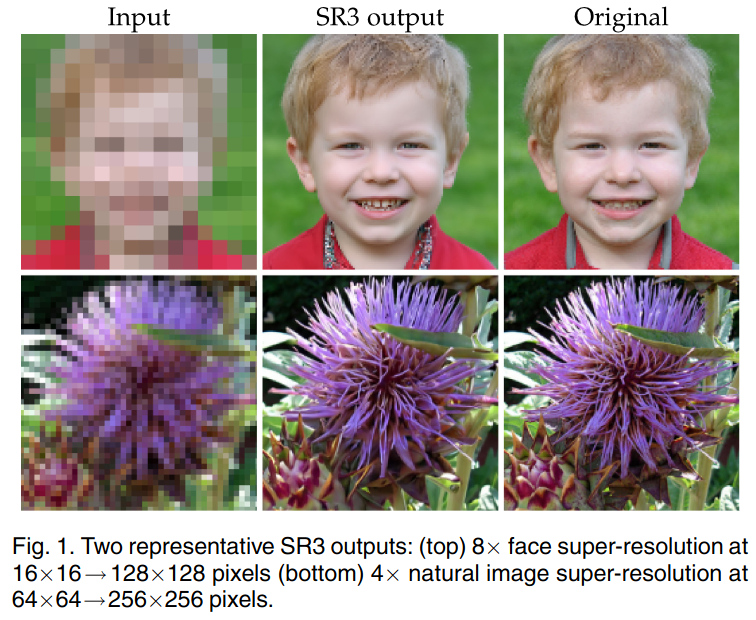
Figure 1. SR3 결과 예시
1. 문제 정의 — 왜 이 논문이 필요한가
- DDPM(stochastic iterative denoising process) 을 이용하여 image-to-image translation (super-resolution) 을 한다.
- U-Net 구조 및 pure Gaussian noise, iterative refinement
- Low-resolution image(resize 해서 high dim 으로 맞춰줌) & high-resolution image 가 concat 되어 input 으로 들어간다.
- Face 뿐만 아니라, natural image 도 잘 작동한다.
-
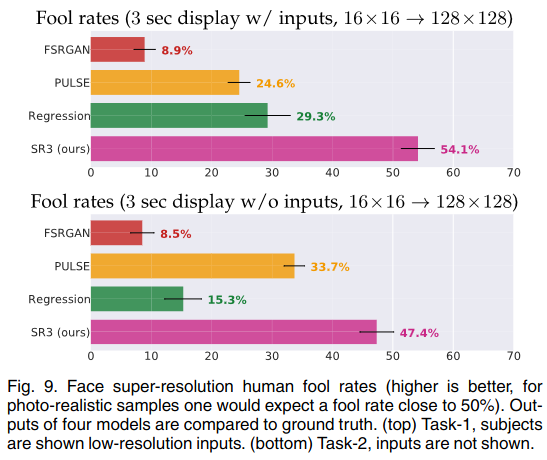
\(8 \times\) face super-resolution task on CelebA-HQ: fool rate \(50\%\) (GAN baselines: fool rate \(34\%\))
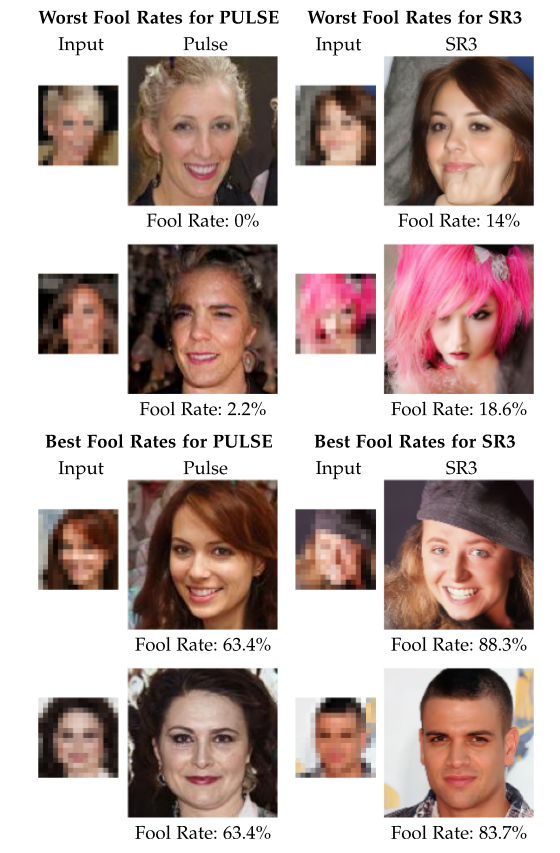
Fool rate: model 이 저해상도 입력 이미지를 고해상도로 생성할 때, 사람이 평가 시 얼마나 현실적으로 보이는지를 나타내는 평가지표이다. 이 지표는 2 개 중에 하나를 선택하는 (2AFC) 패러다임을 기반으로 한다. 즉, 높은 값이 좋다.
-
\(4 \times\) super-resolution task on ImageNet: baseline 과 비교했을 때, human evaluation 과 high-resolution image 로 학습된 ResNet-50 classifier 의 classification accuracy 를 능가했다.
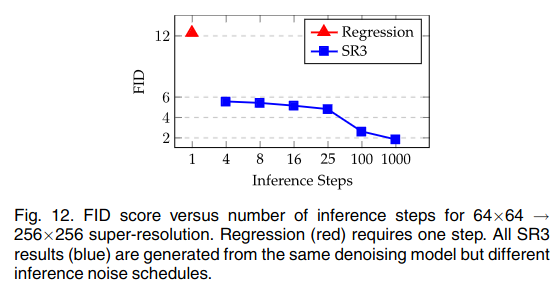
- \(256 \times 256\) ImageNet image generation challenge 에서도 generative model 을 super-resolution model 에 연결시켜, 경쟁력 있는 FID score 를 달성. Cascaded image generation 에서도 효율성을 입증했다.
2. 사전 지식
- Generative models
- Autoregressive models
- Normalizing flows
- VAE
- GAN
- Super-resolution
- MSE loss, regression
3. 방법
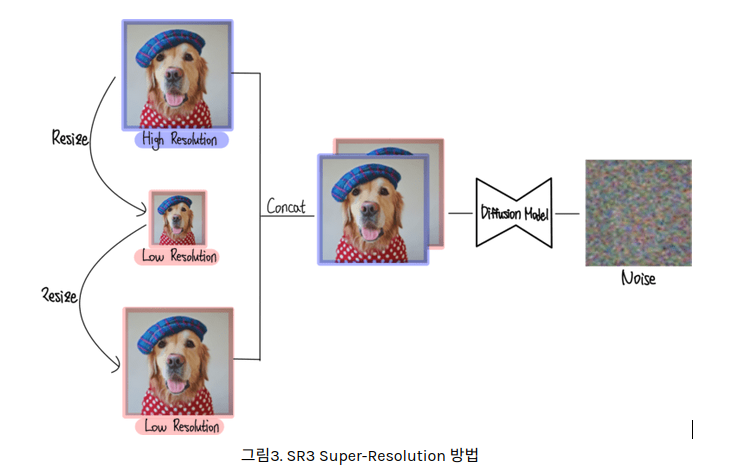
- Notation: 모든 notation 은 DDPM 으로 변환시킨다.
- \(x\): source image, low-resolution image
- \(y\): \(x\) in DDPM, 이미지
- \(y_0\): super-resolution image/ \(x_0\) in DDPM
- \(\gamma_t\): \(\bar\alpha_t\) in DDPM
- \(\beta\): \(\beta\) in DDPM
- \(1- \beta\): \(\alpha\)
- \(\tilde{y}\): \(y_t\) in DDPM, 즉 noisy 한 이미지
- Dataset: input-output image pairs \(D=\{x_i, y_i\}_{i=1}^{N}\)
- Conditional distribution \(p(y|x)\) 는 one-to-many mapping 이다. 즉, 많은 target image \(y\) 는 여러 source image \(x\) 와 일치할 수 있다.
- 따라서, stochastic iterative refinement process 로 source image \(x\) 를 target image \(y\) 로 mapping 시킬 것이다. 여기에 적합한 model 이 바로 DDPM 이고 condition 을 추가하여 conditional image generation system 을 구축한다.
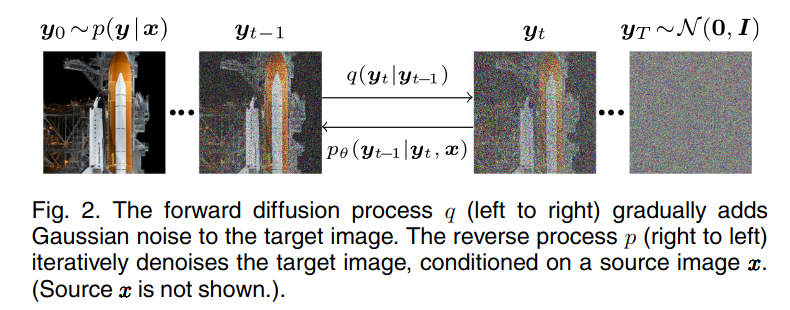
\[ [forward \ process] \ q(y_t|y_{t-1}) \]
\[ [reverse \ process] \ p_\theta(y_{t-1}|y_t, x) \]
- 다시 말해, forward 는 \(y\) 만 given 으로 주고 reverse process using model 은 \(x\) 까지 condition 으로 줘서 denoising 을 하는 꼴이다. 어차피 model 은 이미지 자체를 예측하는 것이 아닌 noise 를 예측해서 다른 algorithm 으로 sampling 하니까 condition 으로 들어가는 게 문제가 되지 않는다. 오히려 정보를 추가적으로 제시하는 것이다.
- 원칙적으로는, \(x\) 도 condition 으로 들어가는 게 맞지만, simple diffusion process 는 \(x\) 에 의존하지 않는다고 논문에서 언급하고 있다.
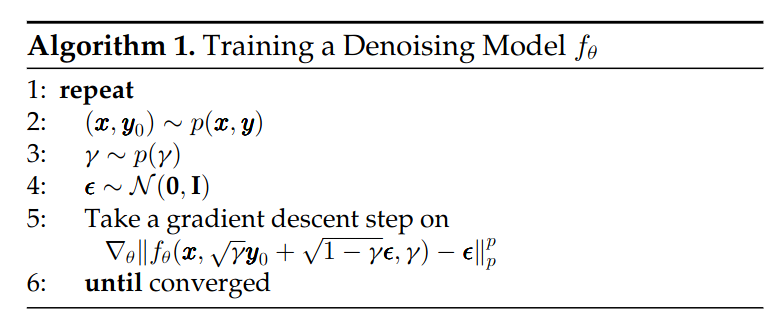
- Training
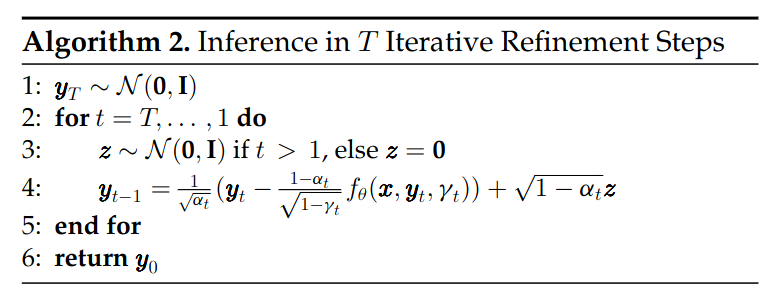
- high-resolution 인 \(y\) 와 low-resolution 인 \(x\) 를 (\(y\) 와 차원이 같음) sampling 해서, \(x\), \(y\), \(\bar\alpha_t\) 를 model 의 입력으로 전달해서 \(\epsilon\) 을 prediction 한다.
- 기존의 DDPM 과 다른 점은 condition 으로 \(x\) 가 들어가는 것과 \(\bar\alpha_t\) 가 들어가는 것이다. time step \(t\) 가 아닌 \(\bar\alpha_t\) 가 들어가는 것은 결국 동일하게 time info(noise level) 를 전달할 수 있기 때문이다.
- Low resolution image 를 condition 형식으로 (물론 input 으로 concat 해서 들어가지만) 넣어서, \(y_t\) 에 들어간 noise 를 예측하는 것이다.
- Inference
- Reparameterization trick 에서 variance 를 \(\tilde{\beta_t}\) 로 하지 않고 \(\beta_t\) 로 뒀다.
- Model Architecture
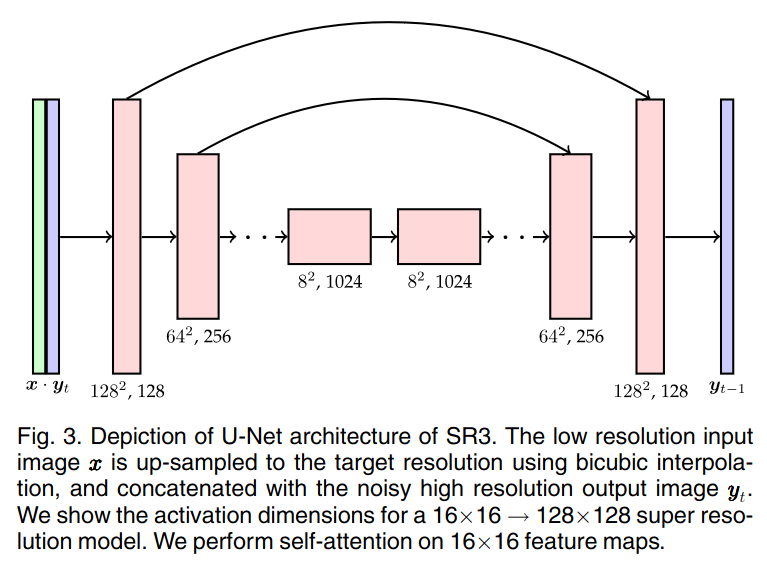
- low-resolution image \(x\) 는 bicubic interpolation 으로 \(y\) 와 동일한 size 를 갖게끔, up-sample 됐다.
- 이때, low-resolution image \(x\) 의 dimension 은 16x16
- \(y\) dimension 은 128x128
4. 실험
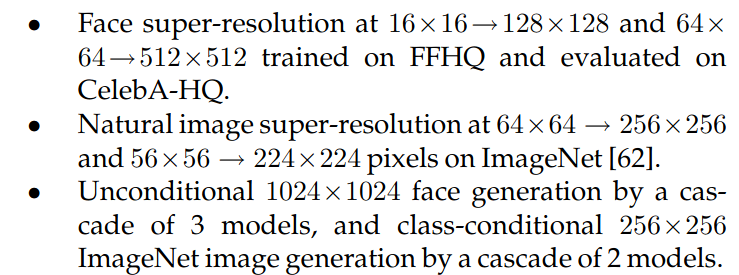
- Experiments on faces, natural images and synthetic images obtained from a low-resolution generative model.
- high-resolution image synthesis using cascaded model.
- Dataset and Evaluation
- Flickr-Faces-HQ(FFHQ) for training and CelebA-HQ for evaluation
- ImageNet 1K for train and eval
- FID and classification accuracy
- Human eval
-
Details
- \(1\) M training steps with a batch size of \(256\)
- Adam optimizer with a linear warmup schedule over \(10\) K training steps
- \(1e-5\) lr
- dropout rate of \(0.2\) for 16x16 -> 128x128. O.W do not use dropout
-
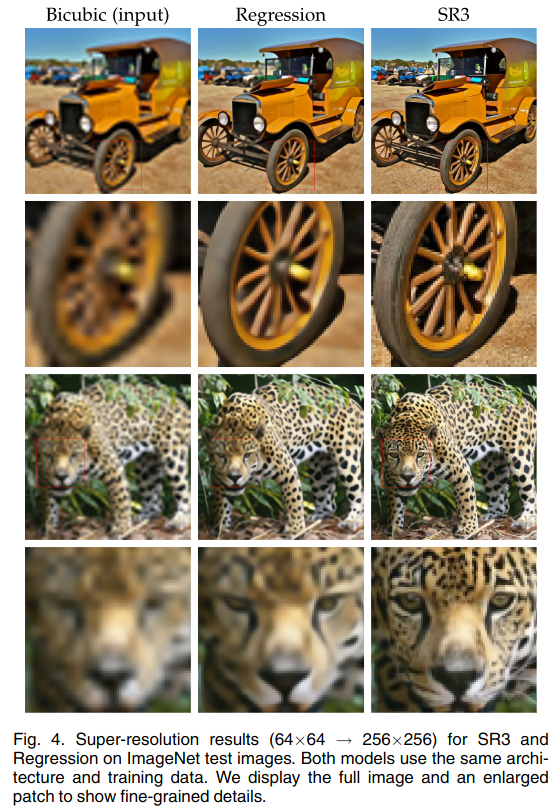
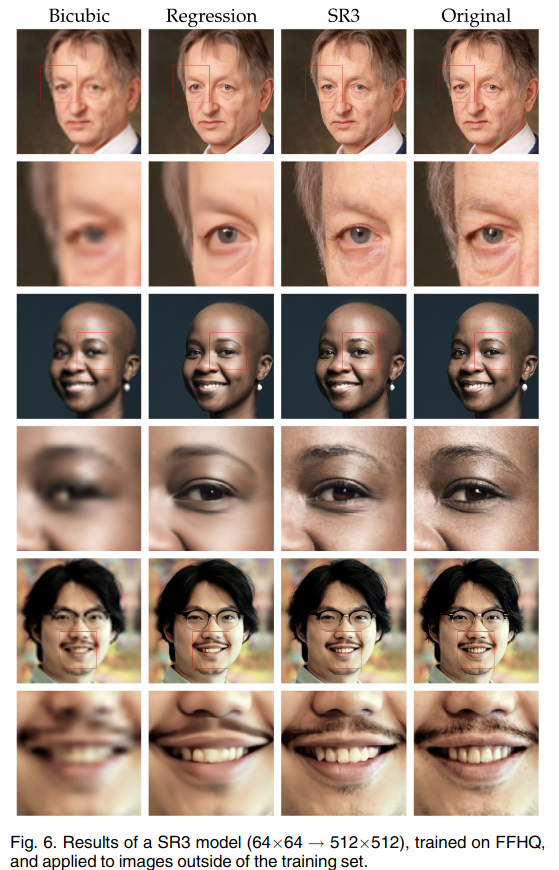
Regression loss 와 비교했을 때의 SR3
5. 정리
- conditional DDPM 을 제안
- Super-resolution task 에 Diffusion model 을 활용
- cascaded model
- Fool rate 가 높은 거로 보아, 사람의 선호도 관점에서 우수한 모델이다.