CP-VTON: Toward Characteristic-Preserving Image-Based Virtual Try-On Network
ECCV(2018), 352 citation
한 줄 요약
학습 가능한 TPS(Geometric Matching Module)로 옷을 사람 형태에 맞춰 warping하고, Try-On Module의 composition mask로 합성해 옷의 texture·logo 같은 특성을 보존한다.
Core Idea: "Use Learnable TPS"
| 흐름 | 내용 |
|---|---|
| 문제 | 기존 image-conditioned 방법은 입력 이미지와 target cloth 사이의 spatial misalignment를 다루지 못하고, hand-crafted shape context matching(VITON)은 coarse-to-fine 구조라 clothing detail을 잃는다 |
| 아이디어 | GMM이 CNN으로 TPS 변환 파라미터를 직접 학습(fully learnable)하고, Try-On Module이 rendered person과 composition mask를 함께 출력해 warped cloth를 통합 |
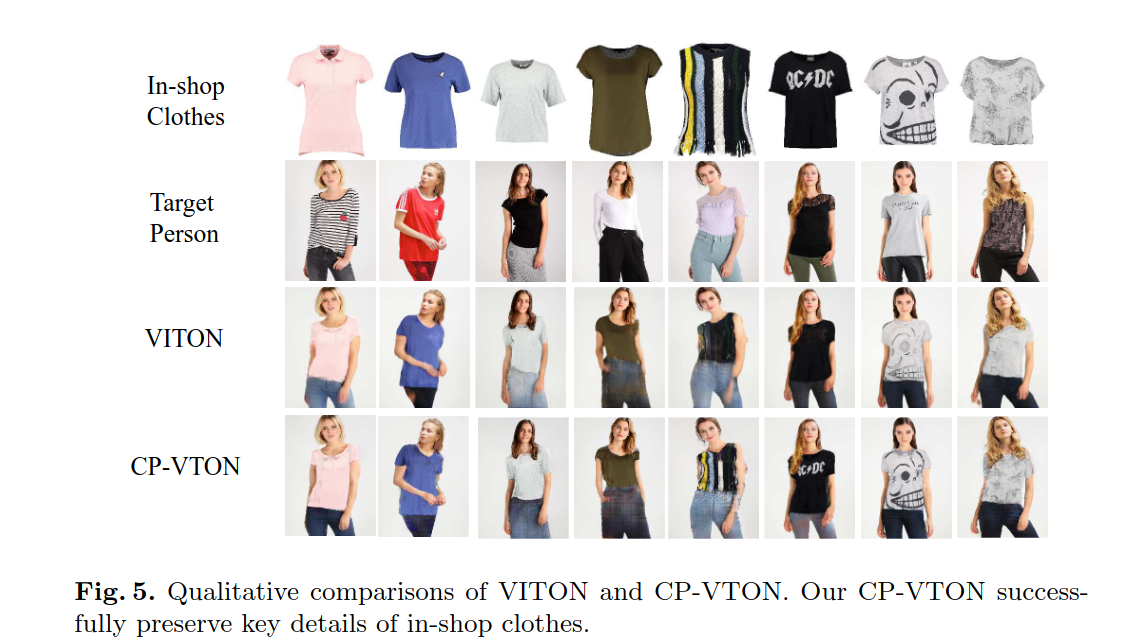
| 결과 | VITON 대비 in-shop 옷의 key characteristic을 더 잘 보존하는 try-on 결과 (VITON dataset, IS·TV norm 기반 LARGE/SMALL 평가) |
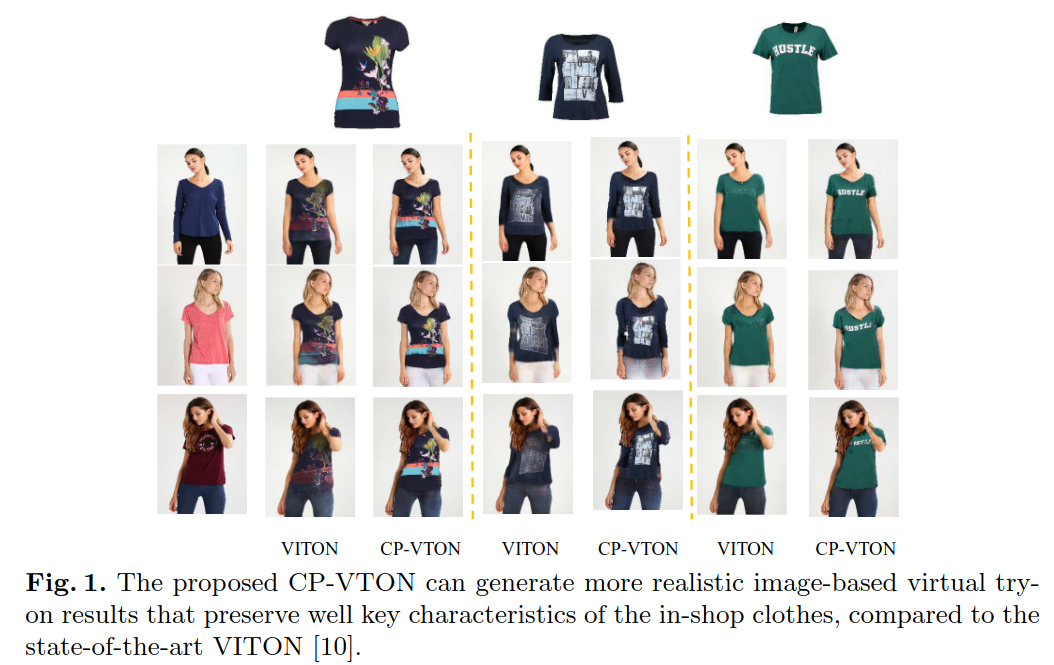
Figure 1. VITON과 CP-VTON의 try-on 결과 비교
1. 문제 정의 — 왜 이 논문이 필요한가
- Desirable (바람직한) pipeline 은 target cloth 를 shape 에 맞춰서 변환시킬 뿐만 아니라, 생성된 이미지에서의 cloth identity 를 보존해야 한다.
- 즉, original cloth 를 묘사하는 key characteristics (e.g., texture, logo, embroidery (자수, 자수품)) 를 잘 보존해야 한다.
- 하지만, 이전의 image-conditioned generation works 는 input image 와 target cloth 사이의 spatial misalignment 를 다루지 못해서, 이런 중요한 요구사항들을 만족시키지 못했다.
- 이전의 연구들은 shape context matching 을 사용하여 명시적으로 spatial deformation 을 다루고자 했다. 하지만, coarse-to-fine strategy 로 인해 clothing detail 을 보존하는데 실패했다.
- 본 연구에서는, real-world challenge 를 다루기 위해 새로운 fully-learnable Characteristic-Preserving Virtual Try-On Network (CP-VTON) 을 제안한다.
-
- CP-VTON 은 new Geometric Matching Module (GMM) 을 통해 cloth 를 target person shape 에 맞추기 위해 thin-plate spline transformation 을 학습한다.
- 이전의 연구에선, interest point 의 correspondence 를 계산했다. (Hand-crafted shape context matching)
- 여기서의 thin-plate spline transformation 은 full learnable 이다.
-
- warped cloth 의 boundary artifacts 를 완화하고, 현실적인 결과물을 위해 warped cloth 와 rendered image 를 통합하는 composition mask 를 학습하는 Try-On Module 을 사용한다.
-
2. 사전 지식
-
Image Synthesis
- GANs: Conditional GAN
- 종종 blurry image 를 만드는 \(L_1, L_2\) loss 와는 다르게 adversarial loss 는 많은 image-to-image task 에서 사용된다.
- 하지만 adversarial loss 는 high-resolution image 를 생성할 때 unstable
- VITON: 마찬가지로 thin-plate spline (TPS) transformation 을 계산한다. 하지만, shape context 는 hand-craft feature 이고 time-consumed
- 게다가, 계산된 TPS transformation 은 predicted mask 에 취약하다.
- 본 논문에서는 TPS transformation 을 CNN 으로 설계했기 때문에, interest point 의 명시적인 correspondence 가 없다.
- GANs: Conditional GAN
-
Person Image Generation
- Virtual Try-On System
3. 방법
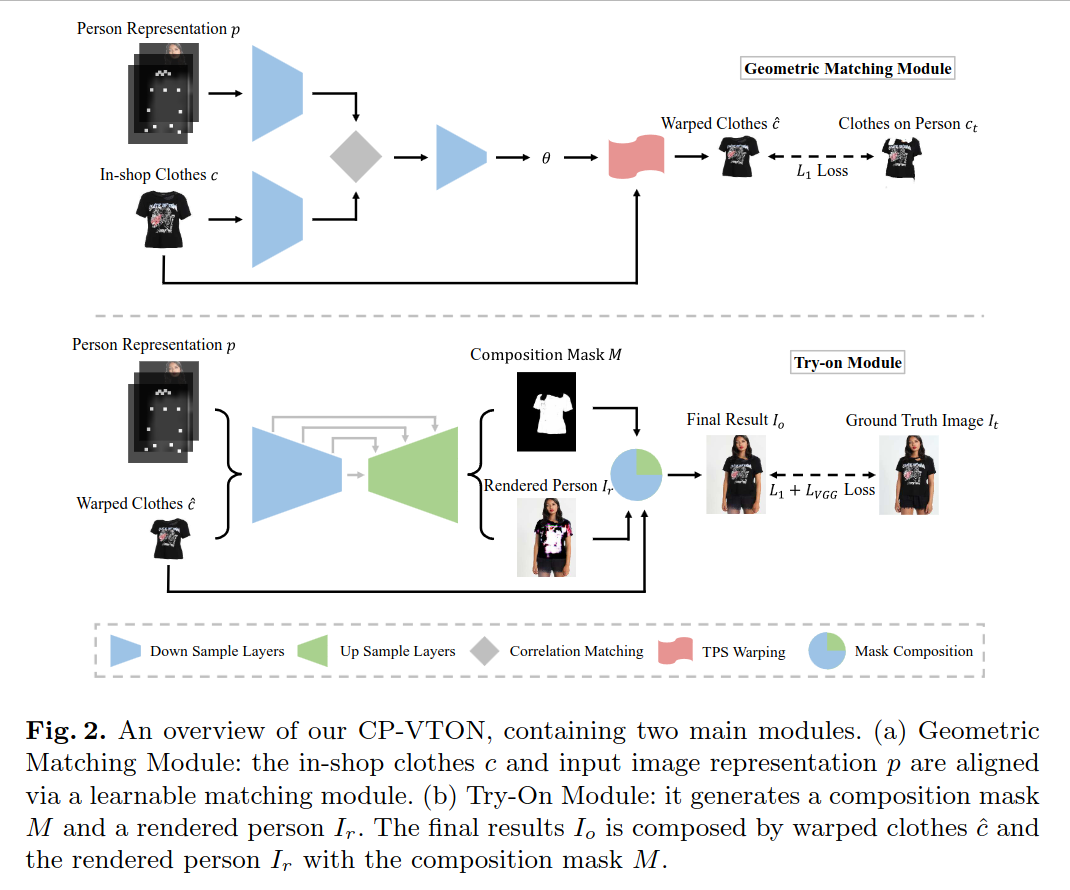
- Overall Architecture
-
Person Representation (Ref. VITON paper)
- Pose heatmap: \(18\) channel feature map, drawn as an \(11 \times 11\) white rectangle
- Body shape: \(1\) channel feature map, blurred binary mask
- Reserved regions: RGB image, regions to maintain the identity of a person, including face and hair
- \(p\): All of feature maps are all scaled to a fixed resolution \(256 \times 192\) and concatenated together, \(\mathbb{R}^{k=22}\)
-
Geometric Matching Module
- new Geometric Matching Module (GMM): given \(c\) and \(p\), transform \(c\) into warped clothes \(\hat{c}\) which is roughly aligned
-
- Extract high-level features of \(p\) and \(c\) via two networks
-
- Correlation layer: combine two features into a single tensor
-
- Regression network: spatial transformation parameters \(\theta\) 를 예측
-
- Thin-Plate Spline (TPS) transformation module \(T\): generate warped image \(\hat{c} = T_{\theta}(c)\)
- Pixel-wise \(L_1\) loss

- Try-on Module
- Geometric Matching Module 로 생성된 warped cloth \(\hat{c}\) 가 roughly align 됐다는 것에 주목해야한다.
- 간단한 방법으로는, 직접적으로 \(\hat{c}\) 를 target person image 에 붙여넣어서 warped cloth 를 모두 보존시킬 수 있겠지만, 이런 방식은 자연스럽지않고 hair, arm 에 의해 사람의 몸이 가려졌을 때에는 오히려 바람직하지 않다.
- 따라서, 본 논문에서는 \(p\) 와 \(\hat{c}\) 를 concat 하고 UNet 구조를 통해 person image \(I_r\) 과 composition mask \(M\) 을 동시에 출력한다.
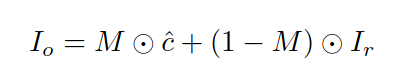
- 그 후, \(\hat{c}, I_r, M\) 을 통해 마지막 출력인 \(I_o\) 를 만든다.
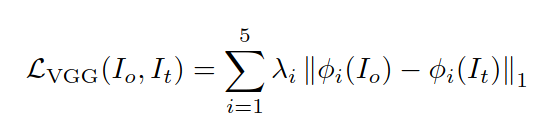
- Loss 는 \(L_1\) loss 와 VGG perceptual loss, \(M\) 에 대한 \(L_1\) regularization loss 의 combination.
- utilize 'conv1_2', 'conv2_2', 'conv3_2', conv4_2', 'conv5_2'
- Characteristic preserving 을 위해 \(L_1\) regularization loss 를 사용한다. Network 의 출력으로 나온 \(M\) 의 모든 원소가 \(1\) 에 가깝도록 학습된다는 얘기는 옷의 정보를 잘 보존한다는 얘기가 된다.

4. 실험
Dataset
- VITON dataset: \(14221/2032\)
- Metric: IS, TV (total variation) Norm
- IS 만으로는 세부 사항이 보존되었는지를 반영할 수 없다.
- TV 로는 세부 사항 풍부도 (detail richness of a clothing image) 를 측정하는데, VITON dataset 이 배경이 순수한 색상이며 TV norm 은 옷 자체에만 영향을 미치기 때문이다.
- Characteristic-preservation 을 평가하기 위해서 가장 큰 clothing TV norm 을 가진 \(50\) 개의 test pair 를 추출하여 LARGE 라고 하고, 반대로 가장 작은 norm 을 가진 \(50\) 개의 pair 를 SMALL 이라고 명명했다.
Implementation Details
-
Training Setup:
- \(L_1, L_{vgg}, mask\) 의 coefficient 는 \(1\)
- GMM, Try-on Module: \(200\) K steps with batch size \(4\)
- Adam: \(\beta_1 = 0.5, \beta_2 = 0.999\)
- Resol. \(256 \times 192\)
-
Feature extraction: 각각 \(2\) 개의 스트라이드 다운샘플링 합성곱 레이어가 \(4\) 개와, \(1\) 개의 스트라이드 다운샘플링 합성곱 레이어가 두 개, 이들의 필터 수는 각각 \(64, 128, 256, 512, 512\) 이다.
- Regressor Network: 두 개의 \(2\) 스트라이드 합성곱 레이어, 두 개의 \(1\) 스트라이드 레이어 및 하나의 완전 연결 출력 레이어를 포함하고 있다. 필터 수는 \(512, 256, 128, 64\) 이다. 완전 연결 레이어는 TPS 앵커 포인트의 \(x\) 및 \(y\) 좌표 오프셋을 예측하므로 출력 크기는 \(2 \times 5 \times 5 = 50\) 이다.
- Try-On Module: \(12\) 개의 레이어 UNet