OmniBooth: Learning Latent Control For Image Synthesis with Multi-Modal Instruction
arXiv(2024), 0 citation, HKUST (홍콩과기대), Review Data: 2024.10.09
한 줄 요약
User mask마다 text 또는 image instruction을 받아 공간·텍스트·이미지 조건을 하나의 고차원 latent control signal(\(lc\))로 통합하고 향상된 ControlNet으로 학습해서, instance-level spatial control이 가능한 multi-modal 이미지 생성을 한다.
Core Idea — "Image Generation Framework that Enables Spatial Control with Instance-Level via Multi-Modal"
| 흐름 | 내용 |
|---|---|
| 문제 | Global text description은 정확하고 복잡한 layout/shape을 표현하기 어렵고, ControlNet·GLIGEN 같은 image condition 방법은 instance-level visual character를 세밀하게 조작하기 힘들다 |
| 아이디어 | Instance별 mask와 CLIP text embedding 또는 image reference(spatial warping으로 인코딩)를 latent control signal \(lc\)로 통합하고, latent input의 feature alignment를 학습하는 향상된 ControlNet 사용 |
| 결과 | User-defined mask set과 text/image guidance로 특정 위치에 다수의 물체를 생성하며, text로 개체 수준 open-vocabulary 생성, image로 개인화된 identity 제어가 가능 |
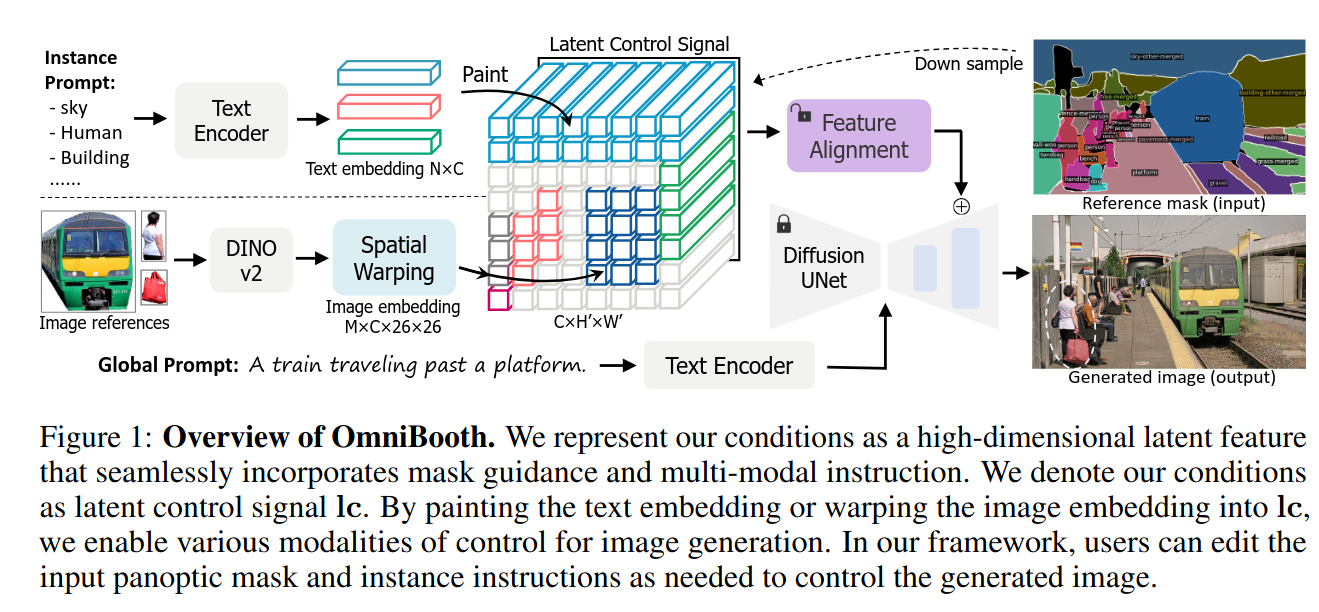
Figure 1. OmniBooth 개요
1. 문제 정의 — 왜 이 논문이 필요한가
배경.
- Diffusion model로 인해 image generation은 큰 발전을 이뤘다.
- User는 원하는 위치에 특정 객체를 생성하고 싶다. 하지만, text-to-image 문맥에서 user는 원하는 이미지를 global text description으로 생성해야 한다. 이는 시각적 환경에서 coarse description만을 제공한다. 언어를 사용해 정확하고 복잡한 layout이나 shape을 표현하기에는 어려움이 있다.
기존 방법의 한계.
- 이전의 work들은 spatial control을 제공하기 위해 image condition을 이용했다. 하지만 이는 instance-level customization을 제공하는 데 한계가 있다.
- ControlNet과 GLIGEN은 다양한 조건의 signal (semantic mask, bounding box layout, depth map)을 사용하지만 instance-level visual character를 조작하는 fine-grained description과 정확한 제공은 힘들다.
이 논문의 접근.
- OmniBooth: spatial control을 multi-modal을 이용해 instance-level로 가능하게 하는 framework
- Text prompt나 image reference를 통해 multi-modal instruction이 가능하다.
- User-defined mask set과 관련된 text/image guidance가 주어지면 특정 위치에 다수의 물체를 생성하는 게 목적이다.
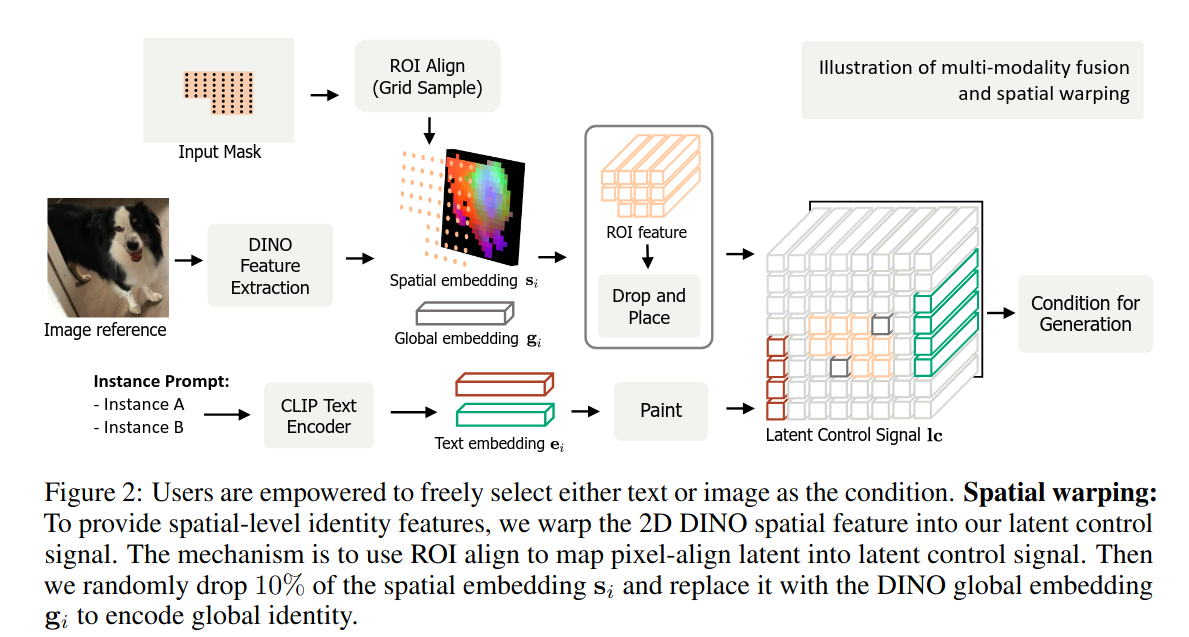
- 본 논문의 핵심 기여는 latent control signal (\(lc\))에 있다. 이는 고차원 공간적 특징으로, 공간적, 텍스트, 이미지 조건을 통합적으로 연결하는 통합된 표현을 제공한다.
- Text condition은 ControlNet을 확장하여 개체 수준의 개방형 어휘 생성을 가능하게 한다.
- Image condition은 더 나아가 개인화된 정체성으로 세밀한 제어를 가능하게 한다.
- Image modality는 더 복잡한 구조를 포함하고 있으므로 공간 왜곡 (spatial warping)을 제안하여 불규칙한 image identity를 \(lc\)에 인코딩하고 변환한다.
- Latent input의 feature alignment를 학습하기 위해 향상된 ControlNet framework를 개발했다.
2. 방법
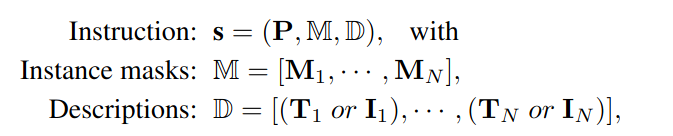
Problem Definition
- \(\mathbf{P}\): global prompt
- \(\mathbf{M}_i\): a binary mask of each instance that indicates their spatial location
- \(D\): instance description
- \(\mathbf{T}_i\): text description of each instance
- \(\mathbf{I}_i\): image description of each instance
Text Embedding
- Textual description \(\mathbf{T}_i\)가 주어졌을 때, CLIP text encoder를 사용해 textual embedding을 추출한다.
- The output (textual embedding) is a 1D embedding \(e_i \in \mathbb{R}^{1024}\)
- 생성되는 이미지의 전체 feature map과 상호작용하는 global prompt \(g_i\)와는 다르게 지역적 control을 위한 instance prompt이다.