StableVITON: Learning Semantic Correspondence with Latent Diffusion Model for Virtual Try-On
CVPR(2024), 0 citation
한 줄 요약
Pre-trained diffusion model에 ControlNet 형태로 옷 정보를 주고 zero cross-attention block으로 latent 공간에서 semantic correspondence를 학습해, 외부 warping module 없이 옷 디테일과 복잡한 배경을 보존하는 try-on.
Core Idea: "ControlNet + Paint by Example for VITON + Attention Total Variation Loss + Augmentation"
| 흐름 | 내용 |
|---|---|
| 문제 | GAN 기반은 복잡한 배경에 일반화가 약하고, diffusion 기반(LaDI-VTON, DCI-VTON)은 CLIP의 공간 정보 손실과 외부 warping module 의존으로 clothing detail 보존이 어렵다 |
| 아이디어 | Zero cross-attention block으로 옷 feature를 UNet에 정렬하고, attention total variation loss와 augmentation으로 attention map을 sharp하게 |
| 결과 | VITON-HD·DressCode로 학습하고 SHHQ-1.0 등 cross-dataset 평가에서 GAN·diffusion baseline 대비 우수한 generalizability |
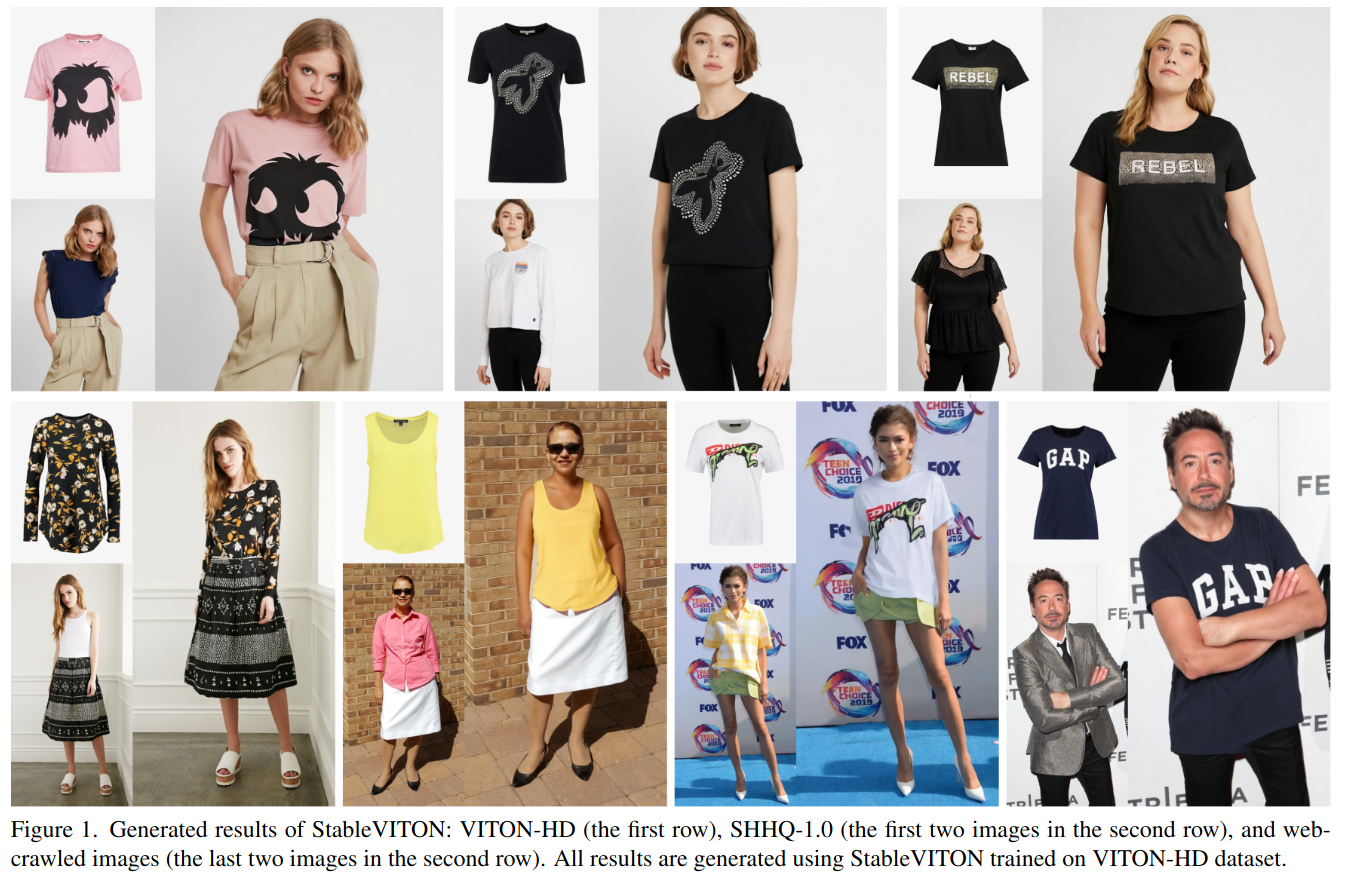
Figure 1. StableVITON 생성 결과 (VITON-HD, SHHQ-1.0, web-crawled 이미지)
1. 문제 정의 — 왜 이 논문이 필요한가
본 논문에서 자주 언급되는 Semantic Correspondence 는 clothing image 를 target person 에 align 이 되게끔 잘 warping 하는 것을 의미한다.
배경.
- Image-based VITON 은 clothing image 와 target person image 가 주어졌을때, target person 에 옷을 입히는 task 이다.
- Dataset 은 clothing image - person image (clothing image 를 입고있는) paired dataset 을 학습한다.
기존 방법의 한계.
-
이전의 방법들은 일반적으로 \(2\) 개의 module 을 포함한다.
- Clothing 과 human body 사이의 semantic correspondence 를 학습하는 warping network
- Warped clothing 과 target person image 를 융합시키는 generator
-
성공적인 발전을 달성했음에도 이러한 방법들은 여전히 문제가 존재한다.
- Generalizability: 다양한 상황에도 작동해야됨
- 특히, 임의의 사람 이미지에 복잡한 background 를 유지하는 게 어렵다.
- 이는 다양한 환경에서의 데이터를 수집하기가 어려워서 generator 의 생성 능력에 제한을 초래한다.
- Generalizability: 다양한 상황에도 작동해야됨
-
StableVITON: Generalizability 의 우월함을 보여준다.
- Meanwhile (한편), large-scale pre-trained diffusion model 의 prior knowledge (강력한 생성능력) 을 바탕으로 high-fidelity human image 를 생성하는데 성공했다. 이는 VITON 으로 확장될 수 있음을 의미한다.
- Strong prior knowledge 를 이용함에도, clothing detail 을 보존하는 것은 중요한 과제이다.
- 이 문제는 제공되는 dataset 을 이용하여 clothing 과 human body 사이의 semantic correspondence 를 학습하여 해결할 수 있다.
- Pre-trained diffusion model 을 사용하는 최근의 방법들은 \(2\) 가지 이슈로 인해 제한적이다.
- Semantic correspondence 를 학습하기 위한 spatial information 이 부족하다. [Ladi-vton]
- Pre-trained model 을 완전히 활용하지 않고, 외부 warping module 에 의존하여 condition 을 정렬하는 옛날 방식처럼 왜곡된 의상을 RGB 공간에 붙여넣는 방식에 의존한다. [DCI-VTON]
이 논문의 접근.
-
Large-scale pre-trained diffusion model 의 strong prior knowledge 를 이용하는 동시에 최근 방법들이 해결하지 못한 문제들을 해결하겠다.
- Semantic correspondence 를 latent space 상에서 학습하겠다.
- Semantic correspondence 를 학습하기 위해 clothing 의 spatial information 을 포함해야하는데, ControlNet with zero cross-attention block 을 통해 intermediate feature 를 전달하겠다.
- Pre-trained diffusion model 의 zero cross-attention block 을 통한 warping 은 \(2\) 가지 이점이 있다.
- Semantic correspondence 를 학습하여 clothing detail 을 보존할 수 있다.
- Warping process 에서 human 에 대한 pre-trained model 의 내재된 지식을 이용하여 high-fidelity image 를 생성할 수 있다.
-
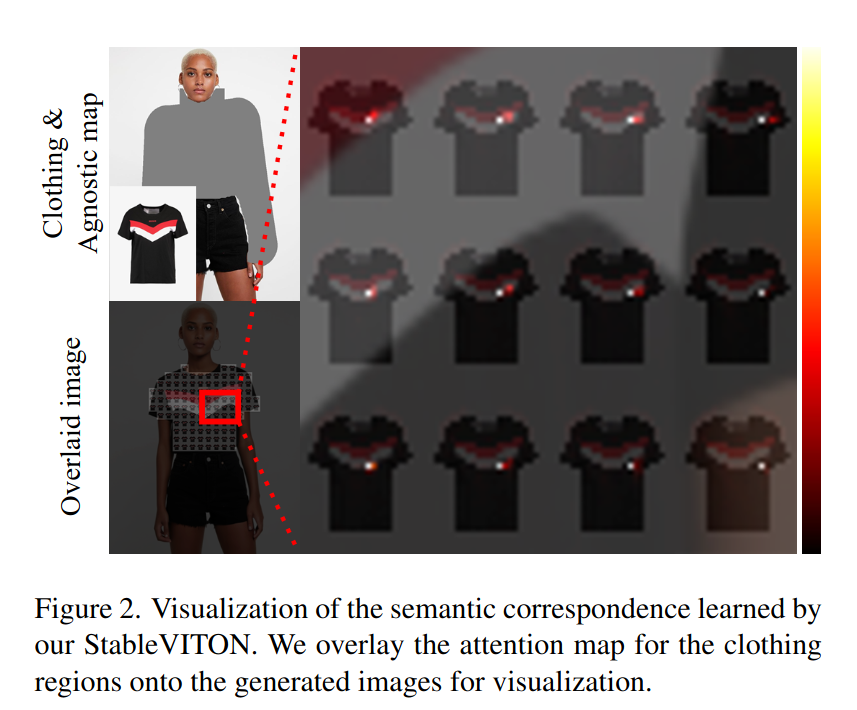
Latent space 에서의 attention mechanism 이 masked region 안에서 각 generated patch 가 clothing 과 일치하는 부분을 보여주면서 patch-wise warping 을 수행하고 있다.
- 즉, attention map 을 보여주면서 생성되는 patch 가 reference image 를 잘 참조하고 있다.
- 더불어서 attention map 을 sharp 하게 만들기 위해 새로운 attention total variation loss 와 augmentation 을 제안한다.
Note
Contributions
- Pre-trained diffusion model 을 온전히 (손상시키지않고) 이용하면서, 기존의 paired dataset 만을 사용하여 복잡한 배경이 포함된 이미지가 제공되더라도 고품질 이미지를 생성한다. (Generalizability)
- 독립적인 외부 warping module 이 없다.
- Semantic correspondence 를 학습하는 zero-cross attention block 을 제안한다.
- 새로운 attention total variation loss 와 augmentation 을 적용했다.
2. 사전 지식
-
GAN-based VITON
- [Parser-free virtual try-on via distilling appearance flows, CVPR, 2021]
- [High-resolution virtual try-on with misalignment and occlusion-handled conditions, ECCV, 2022]
- [Gp-vton: Towards general purpose virtual try-on via collaborative local-flow global-parsing learning, CVPR, 2023]
- \(2\) stage 전략을 사용한다.
- 옷을 적절한 영역에 변환 (warping)
- GAN 을 통해 warped clothing 을 person 과 융합
-
일반화 능력이 부족하다. (복잡한 배경이 있으면 성능이 떨어짐)
-
GAN-based 는 한번에 묶어서 설명함
-
Diffusion-based VITON
- TryOnDiffusion: 두 개의 UNet 을 사용하여 수행. 이 방법은 대용량의 dataset 이 필요하고 모으기도 어렵다. 따라서 large-scale pre-trained diffusion model 을 사용하는 방향으로 연구가 진행된다.
- LADI-VTON: pseudo-word 로 clothing 을 표현
- DCI-VTON: warping network 로 clothing 을 warping 하여 pre-trained diffusion model 에 condition 으로 준다.
- LADI-VTON 과 DCI-VTON 은 배경과 관련된 문제들을 잘 다뤘지만, CLIP encoder 로부터의 과도한 공간적 정보 손실로 인해 high-frequency detail 을 보존하기 힘들다.
- 또한, 독립적인 warping network 로부터 상속된 warped cloth 가 부정확하다면 성능이 저하된다.
3. 방법
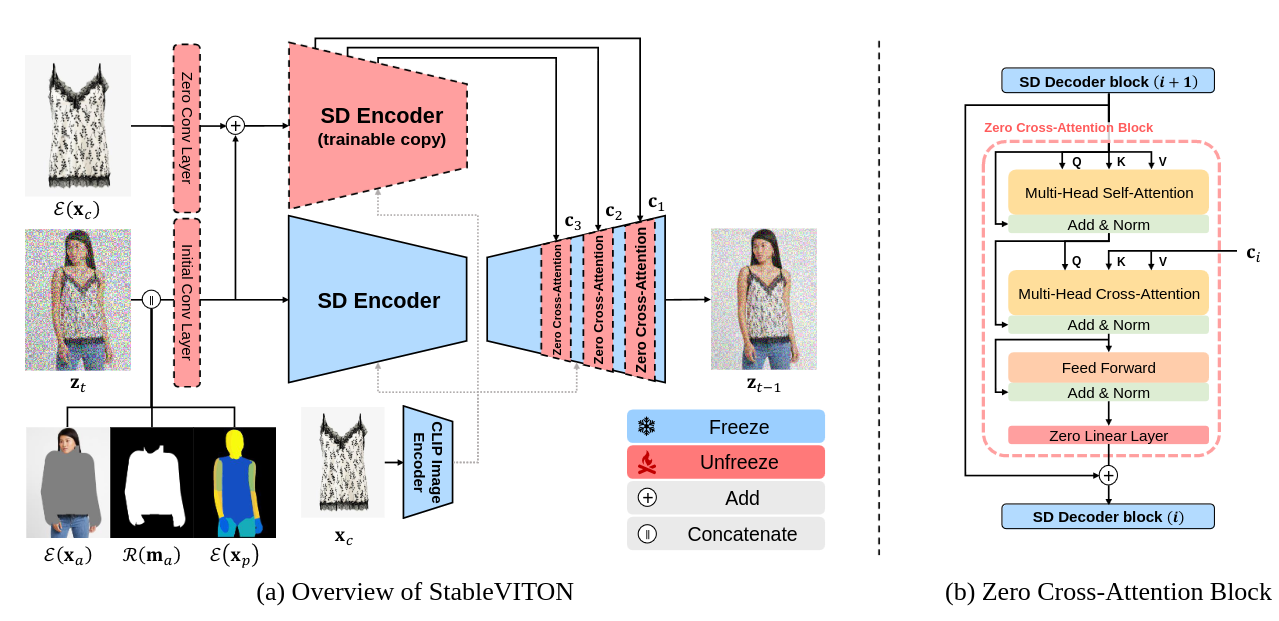
- 본 논문에서는 robust capability of pre-trained diffusion model 를 효과적으로 활용 (Using ControlNet)하여 clothing detail 을 보존하는 데 초점을 맞춰서 진행한다.
- Zero cross-attention block 은 semantic correspondence 를 학습함으로써, clothing detail 을 보존할 뿐만 아니라 warping process 에서 pre-trained model 의 고유 지식을 활용하여 높은 fidelity image 를 생성한다.
- 또한, attention total variation loss 와 augmentation 을 적용하여 정확한 clothing detail 을 초래하는 sharp attention map 을 구축한다.
Problem
- GAN based: background consistency 가 없다.
- Diffusion-based: 옷의 detail 을 반영하지 못한다
- 이는 attention 이 분산되어 있기에 발생하는 문제로써, 본 논문에서 attention total variation loss 를 제안하여 해결한다.
Method
- U-Net input: \(13\) channels
-
- Noisy image: \(Z_t\)
-
- Latent agnostic map \(\mathcal{E}(X_a)\)
-
- Resized clothing-agnostic mask \(X_{m_a}\)
-
- Latent densepose condition: \(\mathcal{E}(X_p)\) to preserve person's pose
-
-
Condition
- \(X_c\) for Image encoder
- \(\mathcal{E}(X_c)\) for ControlNet
-
Zero cross-attention block
- Clothing & human body 사이의 semantic correspondence 를 학습한다.
- Intermediate feature map of clothing 을 UNet 에 조건으로 넣는 것에 초점을 맞췄다.
- Unaligned clothing feature map 을 human feature map 에 더하는 연산은 (기존의 ControlNet) human body 와 clothing 사이의 misalignment 로 인해 clothing detail 을 보존하기에 부적절하다.
- Add: human info 전달
- Zero
- 앞 단의 zero conv: 초기에는 cloth info 를 주지 않는다. 학습할수록 옷의 정보를 잘 학습하도록 kernel 값 조정
- 뒷 단의 zero linear: 기존의 SD 능력을 유지한다. Zero conv 가 아니라면, model output (prediction) 이 정상적으로 나오지 않아서 그에 따라 loss 값의 변동이 커진다. 즉, 학습이 어려워진다.
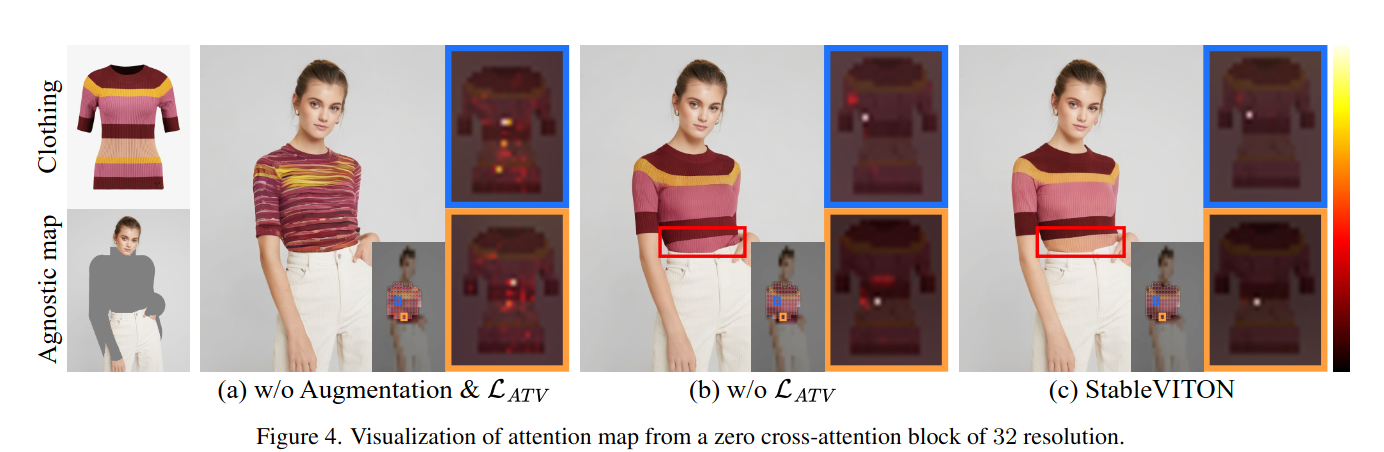
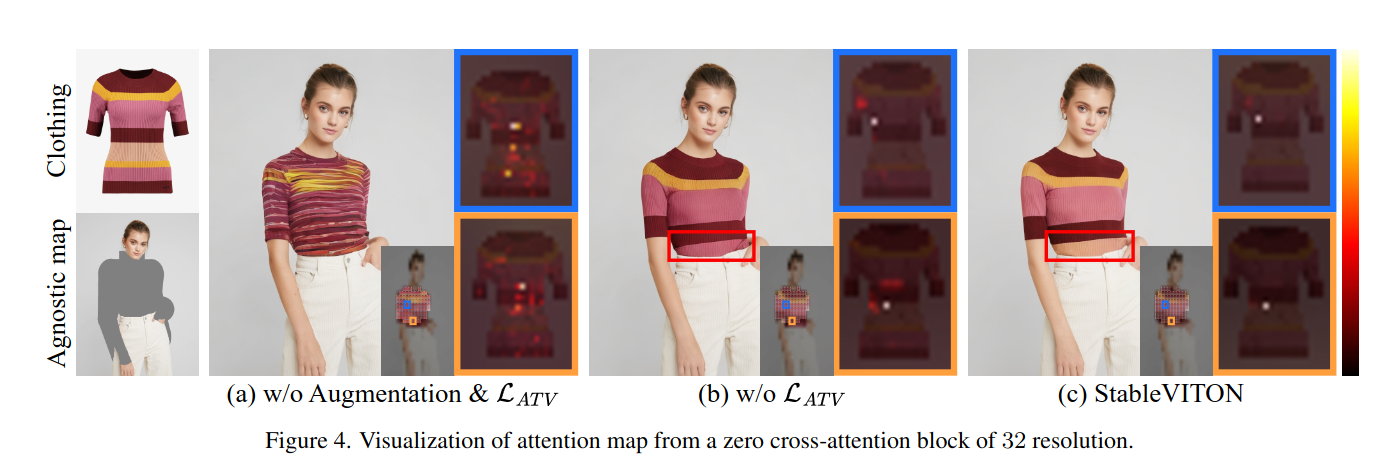
- Semantic correspondence 를 성공적으로 달성하기 위해선, generated image 의 오른쪽 어깨는 clothing 의 오른쪽 어깨 부분과 연관이 있어야 한다; high attention score
-
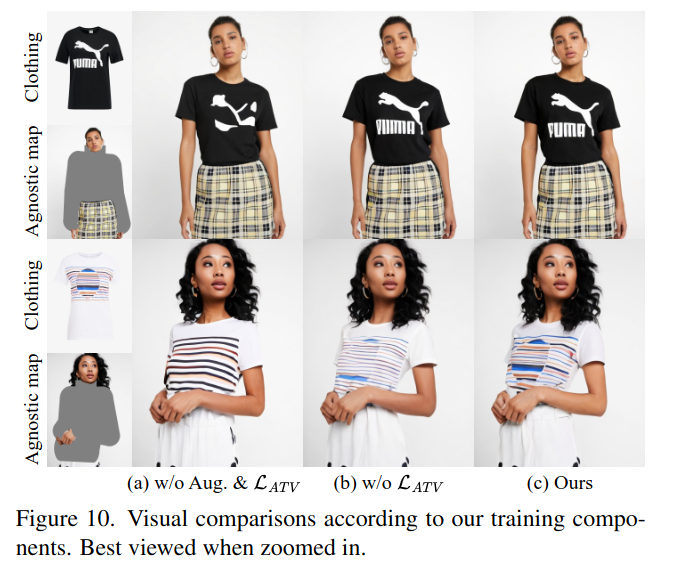
(a): 정확한 semantic correspondence 를 달성하는 것을 실패했다. 이는 color correspondence 와 같은 문제를 발생시킨다.
-
Augmentation: random shift, horizontal flip, random scale
- 이전에 언급했던 misalignment 를 완화시키기 위해 augmentation 을 적용했다.
-
Attention total variation loss
- UNet decoder 에서 ControlNet 과 연결된 cross-attention module 은 \(9\) 개이다.
- \([0, 1, 2, 3, 4, 5, 6, 7, 8]\): \(3\) 개씩 같은 resol 이다. 차례대로 \(16, 32, 64\) resolution.
- 실제 코드에선, \(4\) index 즉, \(32\) resolution 에 대해서 이 loss 가 적용되었다. 제안된 loss 는 학습된 모델이 어느정도의 location mapping 이 잘 align 되어있어야 효과적으로 쓸 수 있는 거 같다.
- 옷의 색깔이 맞지 않는데, attention score 가 분산되어 있어서라고 가정했다.
- 잘 학습된 모델을 대상으로 (어느 정도의 location align 이 되어있어야 한다) attention map 의 center coordinate 의 variation 을 최소화하면, 중심 좌표들간의 변동이 최소화되면서 일관된 위치에 주의를 집중하게 된다.
- 또한, Cross-attention 에서의 clothing 과 warped clothing 간의 location align 을 일치시키는 효과가 있다. (중심 좌표들간에 충돌을 막아주는 효과)
- E.g., color discrepancies (옷의 색깔이 맞지 않는다)
- 여기서 center coordinate map 이란, generated patch \(i\) 에 영향을 주는 reference attribution map (clothing) 의 high attention score 들의 average location 이자 map 에서 가장 중요한 위치 라고 볼 수 있다.
- 일반적인 무게 중심을 구하는 식에서 각 위치에서의 attention score 를 곱해준 꼴인데, 이건 attention score 를 weight 로써 일반적인 무게중심이 아니라 high attention score 를 더 고려한 무게 중심이다.
- 극단적으로 양 극단의 중심좌표가 다를텐데, 이 사이의 값들의 total variation 을 줄여야 하므로 한 극단으로 갈수록 중심 좌표의 값들이 천천히 변화하여 도달할 것이다.
- UNet decoder 에서 ControlNet 과 연결된 cross-attention module 은 \(9\) 개이다.
-
\(32 \times 24\) cross-attention in zero cross-attention block
- Attention total variation loss 와 augmentation 을 사용하면, Cloth 와 human body 의 align 이 잘 된다.
- Clear visualization 을 위해, generated image 를 \(32 \times 24\) 로 먼저 downsampling 하고 다시 \(32^2 \times 24^2\) 로 resize 했다.
- 이후에, attention map 에 각 query token 을 overlay 했다.
4. 실험
- 본 모델은 \(1024 \times 768\) resolution 으로도 가능하지만, fair evaluation 을 위해 \(512 \times 384\) 로 학습했다.
Comparison method
- GAN-based: VITON-HD, HR-VITON, GP-VTON
- Diffusion-based: LADI-VTON, DCI-VTON
- Paint-by-Example
\(\textbf{Dataset}\): VITON-HD, Dress-Code (virtual try-on datasets), SHHQ-1.0 (human image dataset)
- VITON-HD 와 upper-body images in DressCode 로 학습했다.
- 근데 두 개를 합쳐서 학습은 하지 않고 독립적으로 학습. 즉, 모델이 \(2\) 개
-
Evaluation 은 SHHQ-1.0 으로 했다.
-
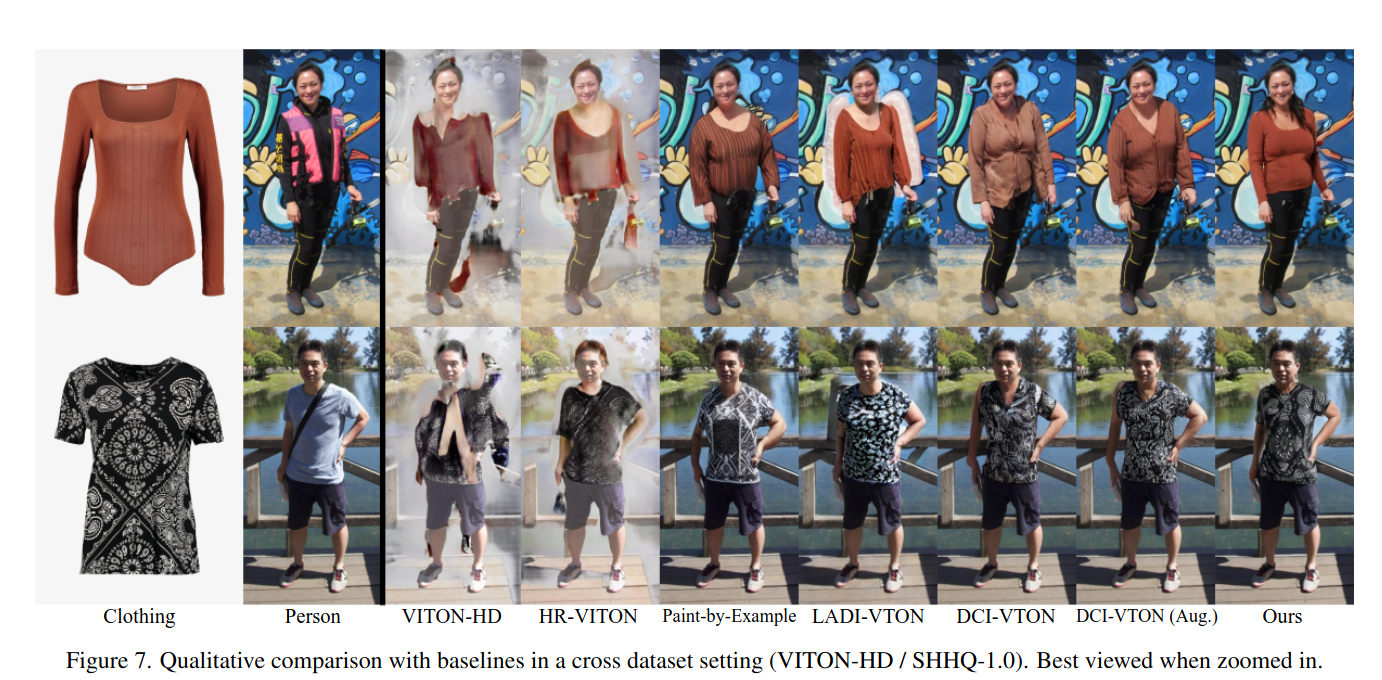
Qualitative comparison
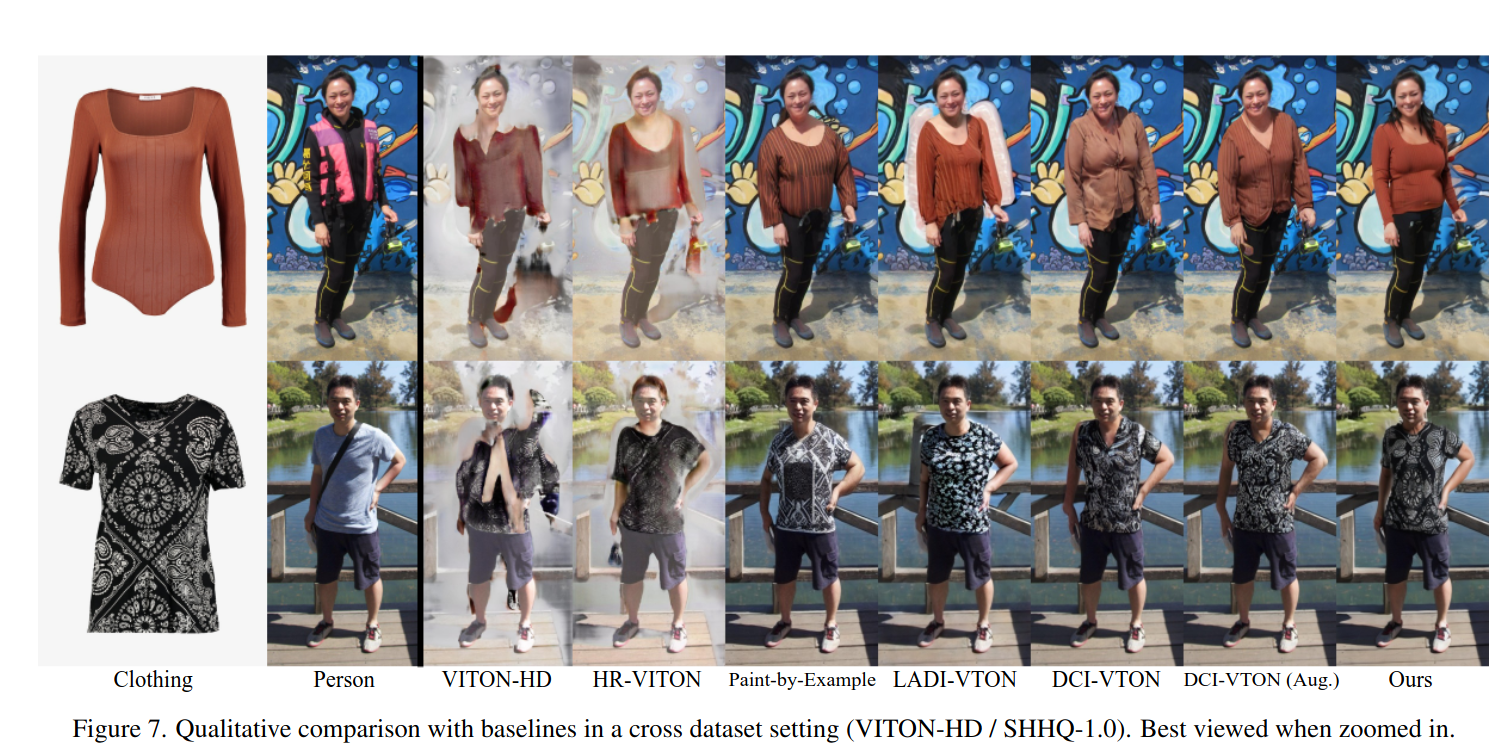
- Single dataset evaluation: same Train/Test dataset source
- Cross dataset evaluation: different Train/Test dataset source
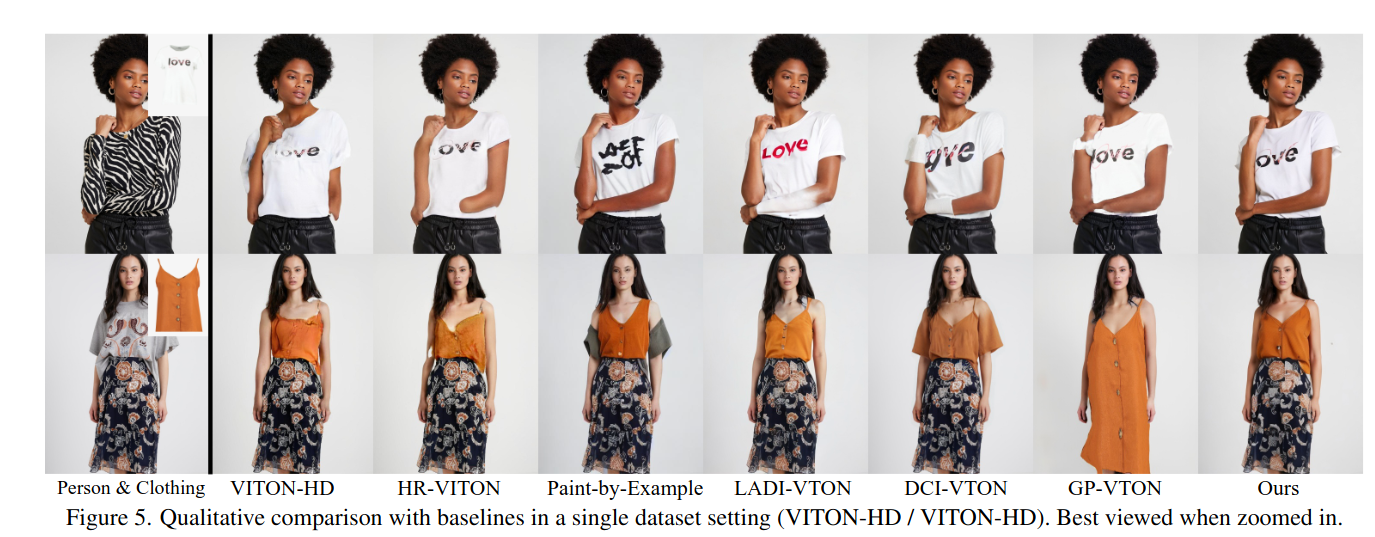
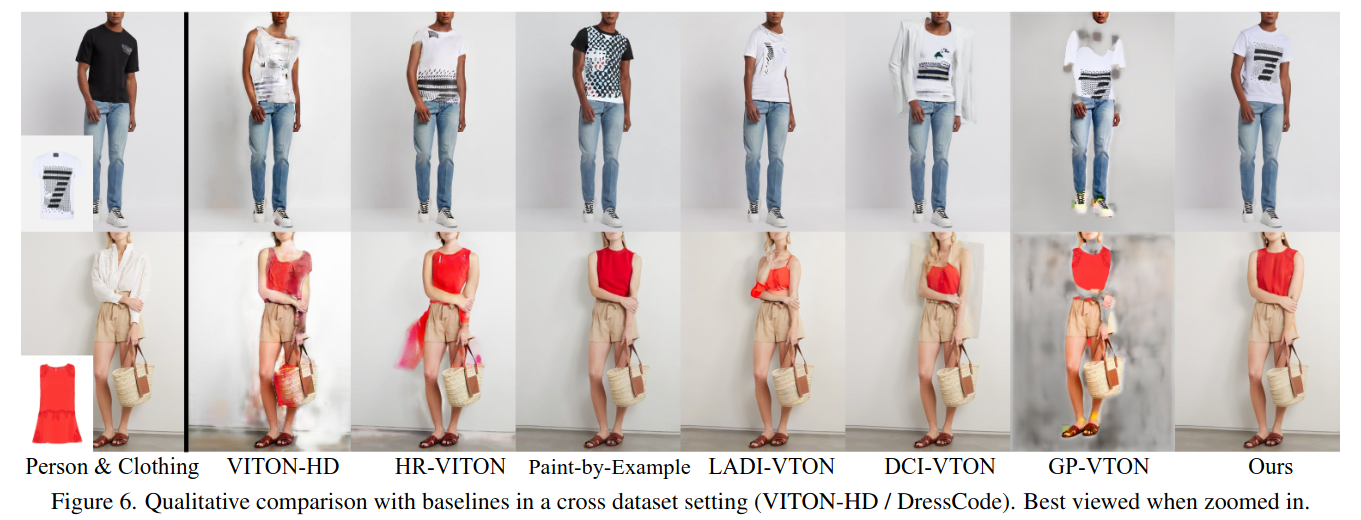
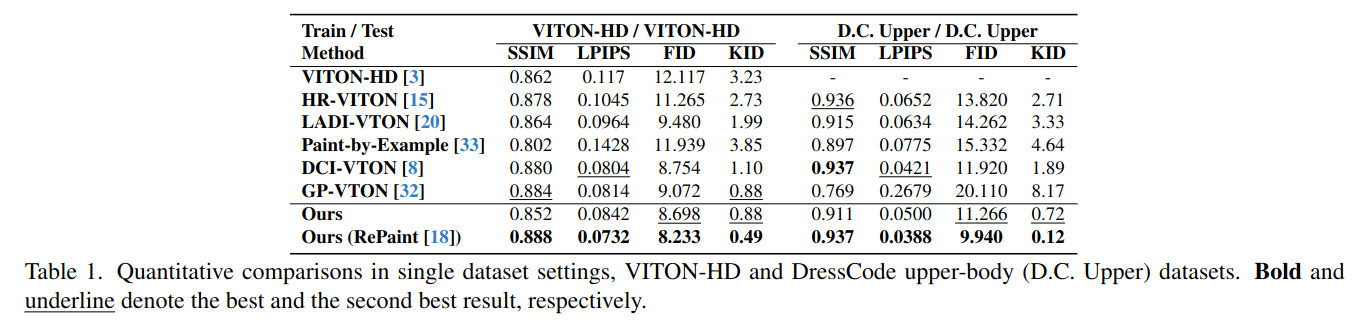
- Quantitative comparison
- Paired setting: person/original clothing
- Unpaired setting: person/different clothing
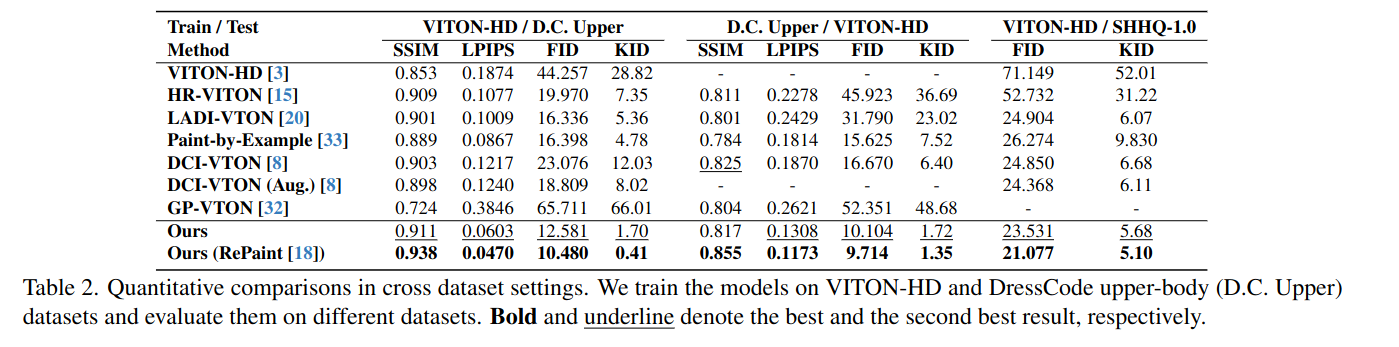
- Qualitative comparison with baselines in a cross dataset setting (VITON-HD / SHHQ-1.0).
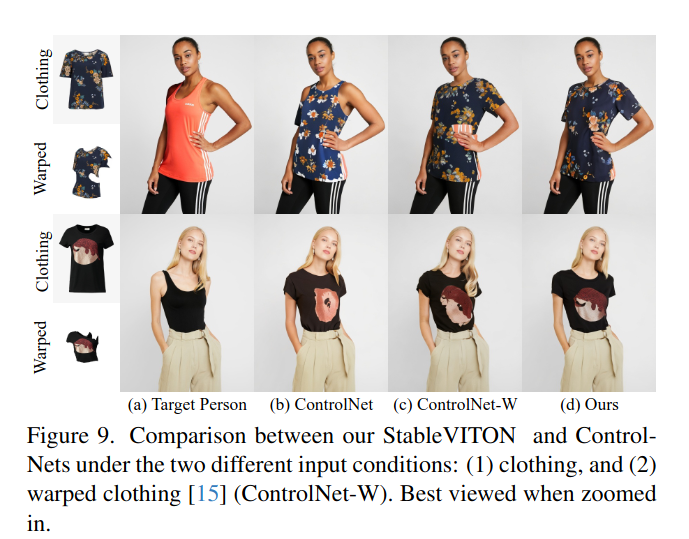
- ControlNet 과의 비교
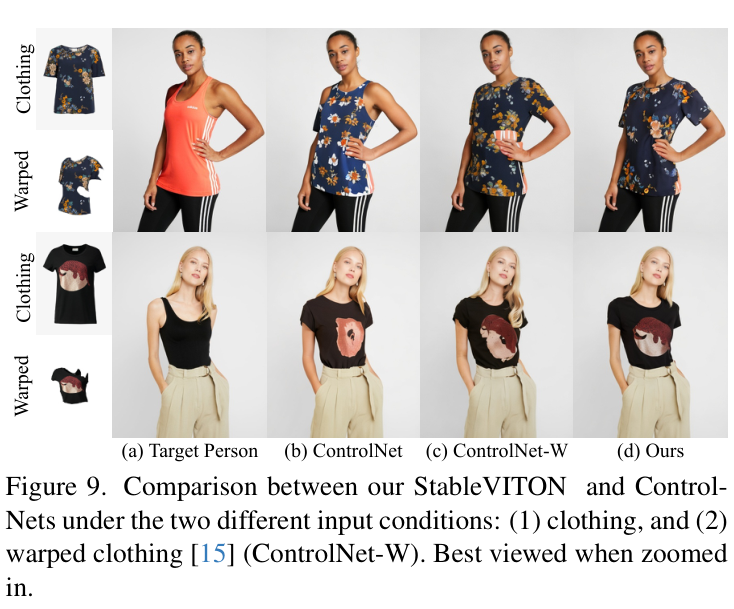
-
Blending(Repaint) 을 사용하면 성능이 더 올라간다.
- Masked region 밖은 원본 이미지로 replace
-
Ablation Study
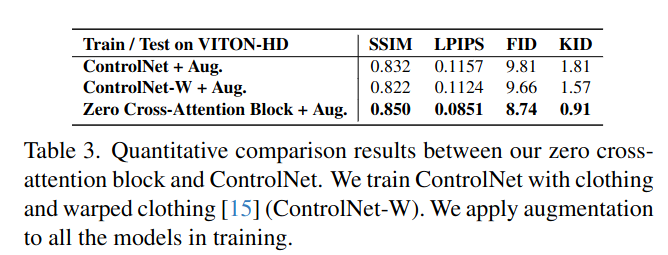
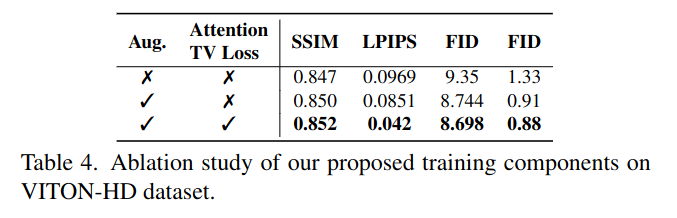
5. 정리
- Pre-trained diffusion model: warping process, clothing detail
- Zero cross-attention block: train semantic correspondence \(\rightarrow\) clothing detail
- Attention total variation loss: sharp attention map \(\rightarrow\) clothing detail
- Augmentation: clothing detail
6. 질문 & 메모
-
CLIP Image encoder 에 똑같이 cloth 를 넣어주는 이유?
- Classifier free guidance 를 사용하기 위해서도 맞고
- SD 를 copy 했다는 말은 ControlNet 구조에서도 condition 을 받아야한다는 말이 되므로 ControlNet 을 제외한 condition 이 하나 더 있어야 한다. 그게 CLIP Image encoder
-
What is difference from ControlNet?
- ControlNet 과는 다르게 더해주지 않고 Cross attention 을 학습시켰다.
- Loss term
-
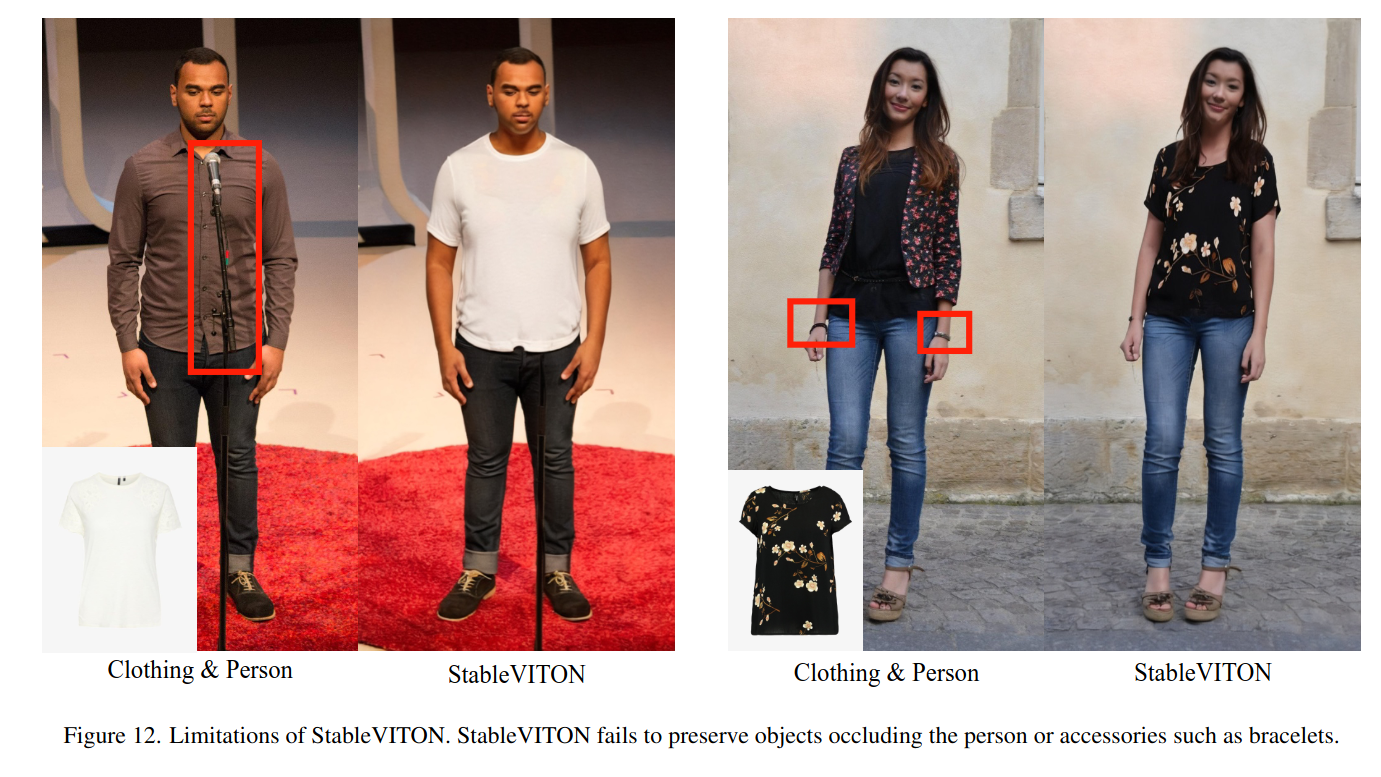
Limitation
-
장신구의 보존/object 에 가려졌을 때, object 가 사라짐
- 그럼에도 복잡한 환경에서 생성을 어느정도 잘 한다.