DiffusionCLIP: Text-Guided Diffusion Models for Robust Image Manipulation
CVPR(2022), 465 citation, KAIST, Review Data: 2024.07.15
한 줄 요약
Real image를 DDIM inversion한 뒤, reverse process의 score function을 CLIP directional loss와 identity loss로 fine-tune해서, GAN inversion의 한계 없이 text prompt 기반 zero-shot image manipulation을 robust하게 수행한다.
Core Idea — "Perform Zero-Shot Image Manipulation with Diffusion Models Via CLIP Loss"
| 흐름 | 내용 |
|---|---|
| 문제 | CLIP + GAN inversion 기반 zero-shot manipulation은 제한된 inversion capability 때문에 새로운 포즈·시각·물체 재구성에 약해 object identity가 바뀌거나 원하지 않는 artifact가 생긴다 |
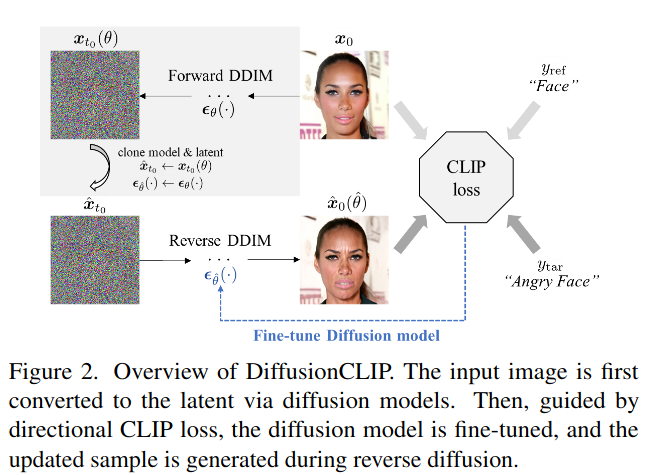
| 아이디어 | DDIM inversion으로 얻은 noisy image에서 다시 생성하며, local directional CLIP loss와 \(L_{id}\)로 diffusion model을 fine-tune. Return step \(t_0 < T\)까지만 forward하는 fast sampling |
| 결과 | 신뢰성 있는 real image 조작, unseen domain 간 translation과 stroke-conditioned synthesis, noise combination을 통한 multi-attribute manipulation이 가능 |
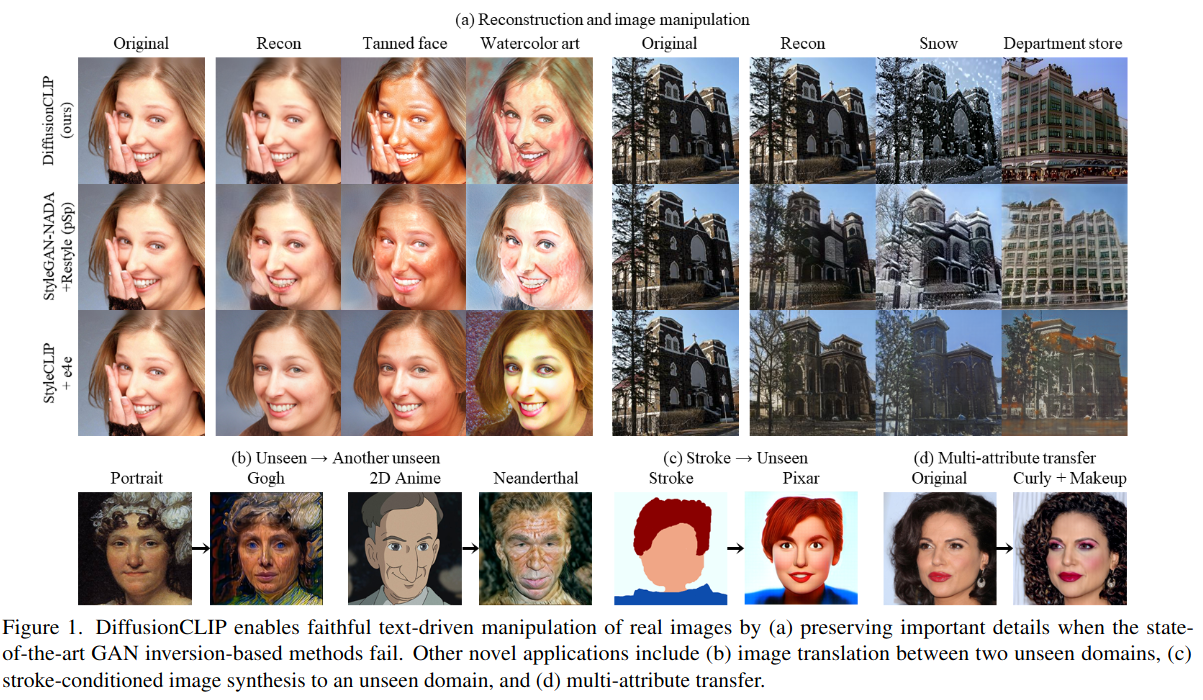
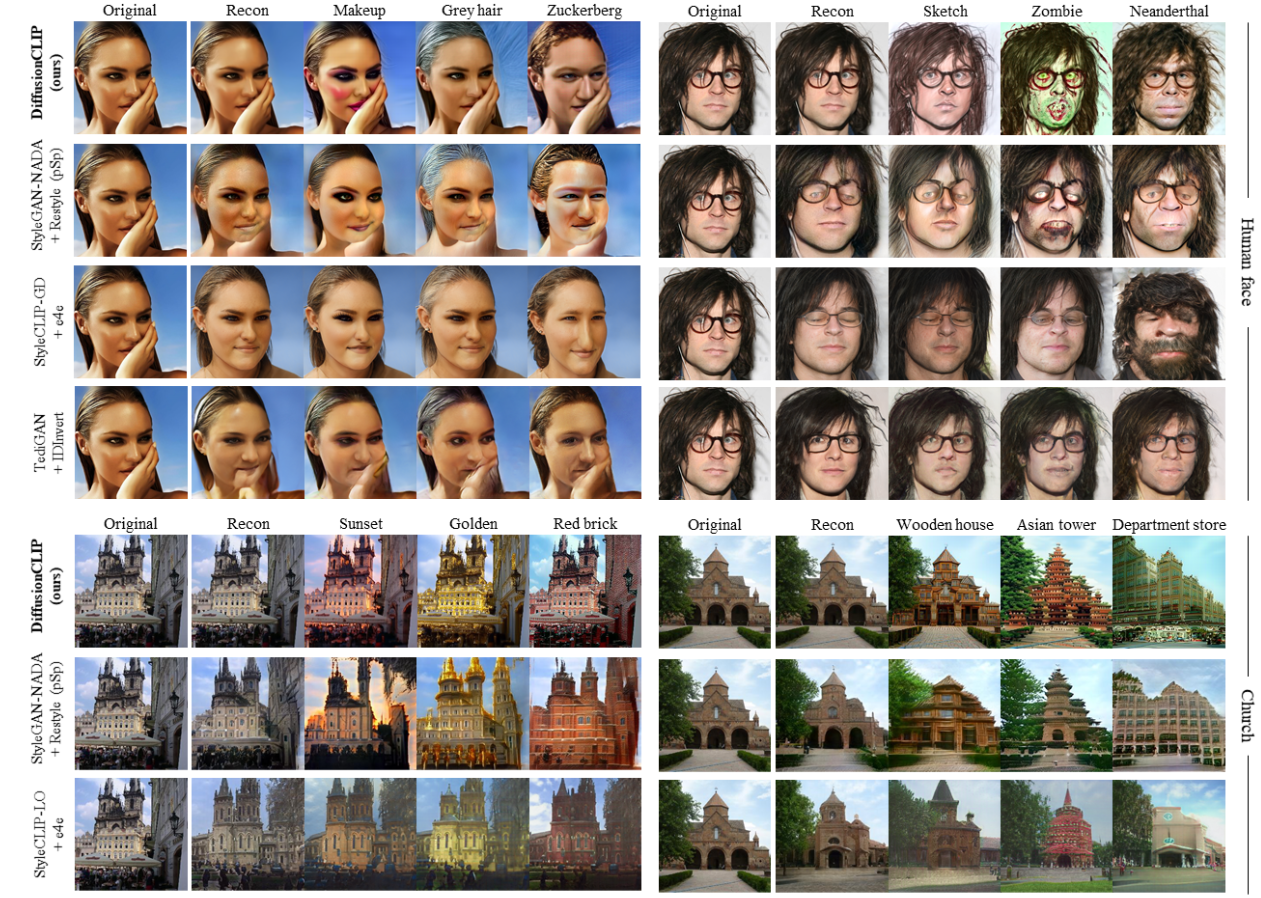
Figure 1. DiffusionCLIP 개요
1. 문제 정의 — 왜 이 논문이 필요한가
배경.
- Zero-shot image manipulation
기존 방법의 한계.
- CLIP과 결합된 GAN inversion method들은 text prompt에 의한 zero-shot image manipulation이 가능하다.
- 하지만, 제한된 GAN inversion capability로 인해 다양한 real image의 application으로는 여전히 어려움이 있다.
- 구체적으로, 이런 접근법들은 종종 새로운 포즈, 시각, 물체 등의 재구성에 어려움이 있고 이는 training data와 비교해서 object identity를 바꾸거나 원하지 않는 image artifacts를 생성한다.
이 논문의 접근.
- 이러한 문제들을 완화시키고 신뢰성있는 real image 조작을 위해 DiffusionCLIP을 제안한다.
- Unseen domain에도 잘 작동한다.
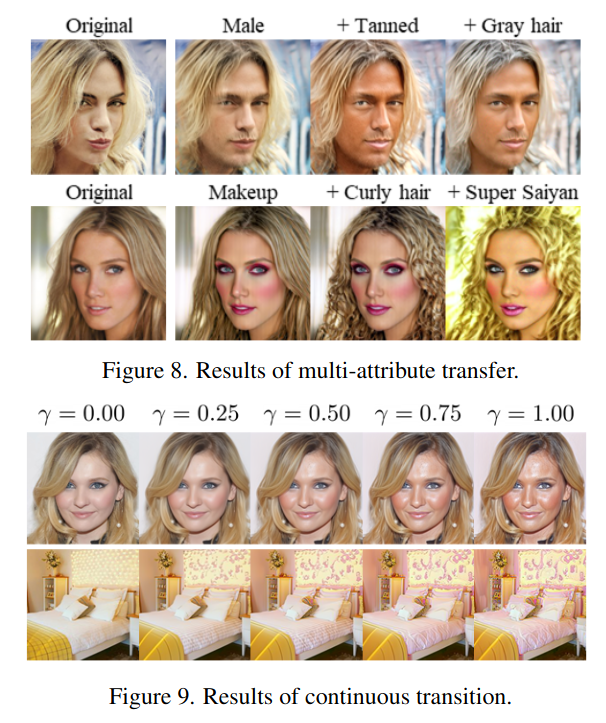
- Novel noise combination: multi-attribute manipulation을 가능하게 한다.
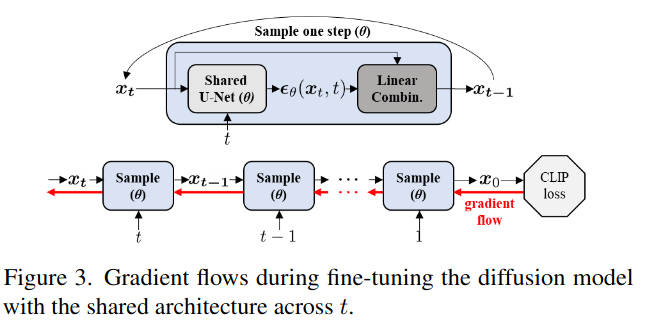
- Key idea: reverse diffusion process에서 text prompt에 기반한 생성된 이미지의 attribute를 조절할 수 있는 CLIP loss를 사용하여 score function을 fine-tune한다.
2. 방법
- Latent diffusion model이 아닌 pixel diffusion model이다.
CLIP loss
- CLIP loss: Global target loss \(+\) local directional loss로 이루어져 있다.
- Global target loss: 생성된 이미지와 주어진 target text사이의 CLIP space상에서 cosine distance를 최소화한다.
- Local directional loss: 적은 다양성 및 adversarial attack의 민감성과 같은 global CLIP loss의 문제들을 완화하기 위해서 설계됐다.
- 참조 이미지와 생성된 이미지의 embedding사이의 방향을 유도한다.

- 참조 이미지와 구별되는 이미지를 생성하면서도, 참조 텍스트와 target 텍스트 간의 방향을 정렬시켜야 되기 때문에 mode-collapse issue에 강건하다.
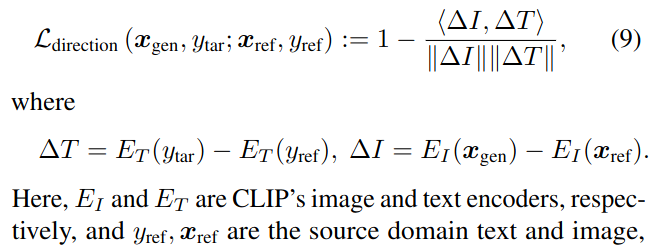
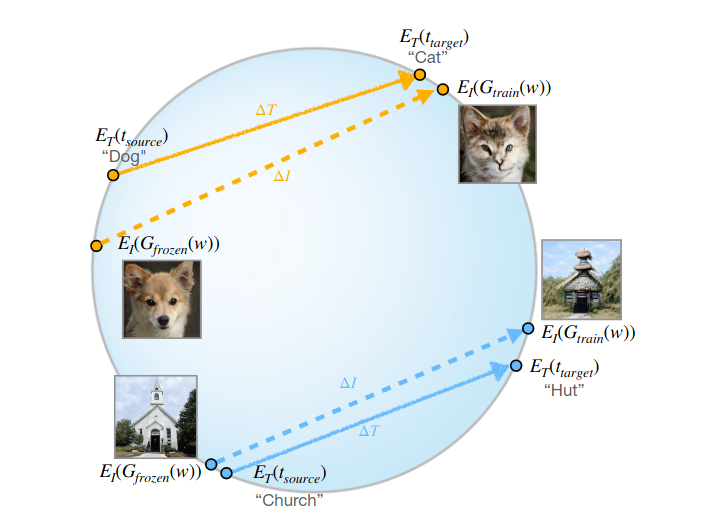
- Reference image를 DDIM inversion으로 noisy image를 만들고, 다시 DDIM으로 생성을 한다.
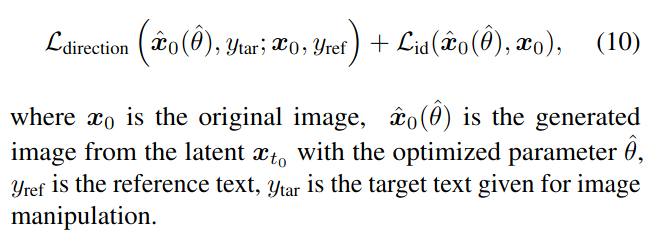
- 본 논문에서 사용하는 CLIP loss는 다음과 같다.
- Global loss는 안 쓰는 거 같다.
- \(L_{id}\): object의 identity를 보존하고, 원하지 않는 변화를 방지하기 위해 사용한다.
- \(L_{face}\): face identity loss

Fast sampling strategy
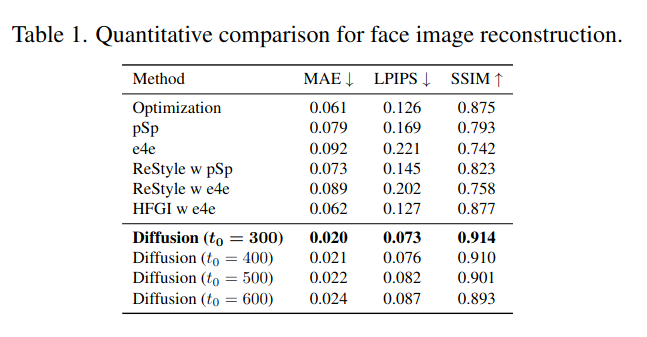
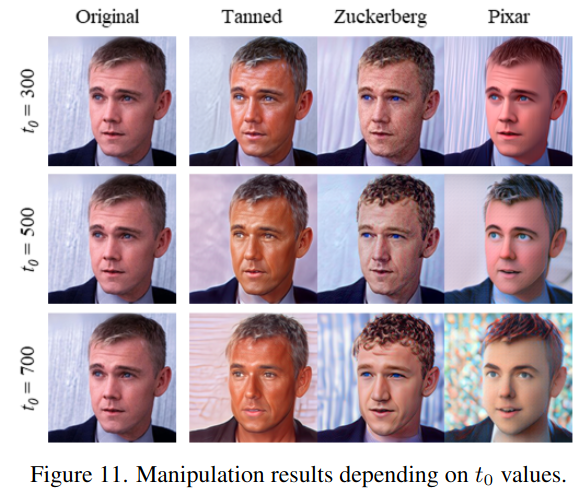
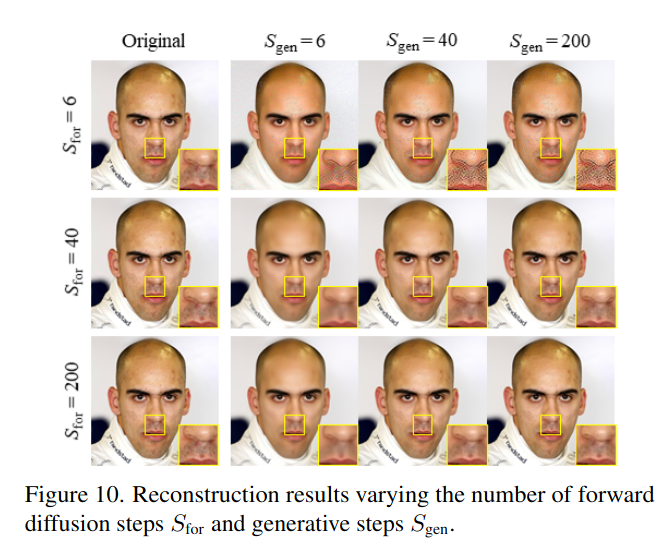
- Last time step \(T\)까지 forward diffusion을 수행하는 대신에, \(t_0 < T\)까지 한다. \(t_0\)를 return step이라고 부른다.
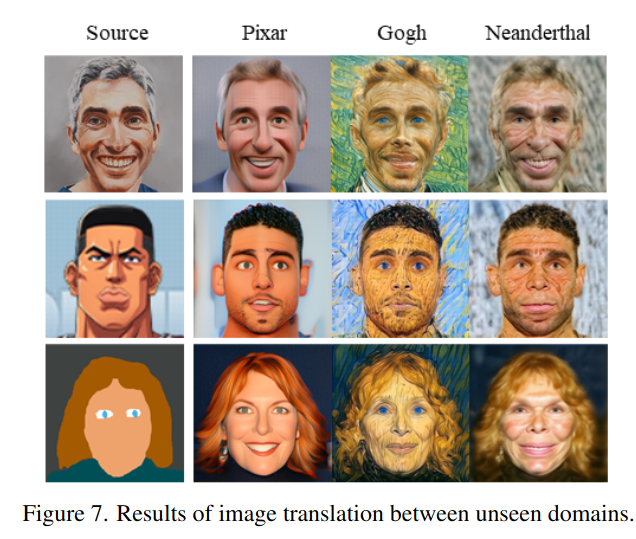
Image translation between unseen domains
- Unseen domain에서 다른 unseen domain으로 translation을 할 수도 있고 unseen domain에서의 stroke-conditioned image synthesis도 가능하다.
- SDEdit처럼 domain-related component는 blurry하게 (못 알아보게) 만들면서 identity/semantics of object는 보존하는 \(t_0\)를 찾는다.
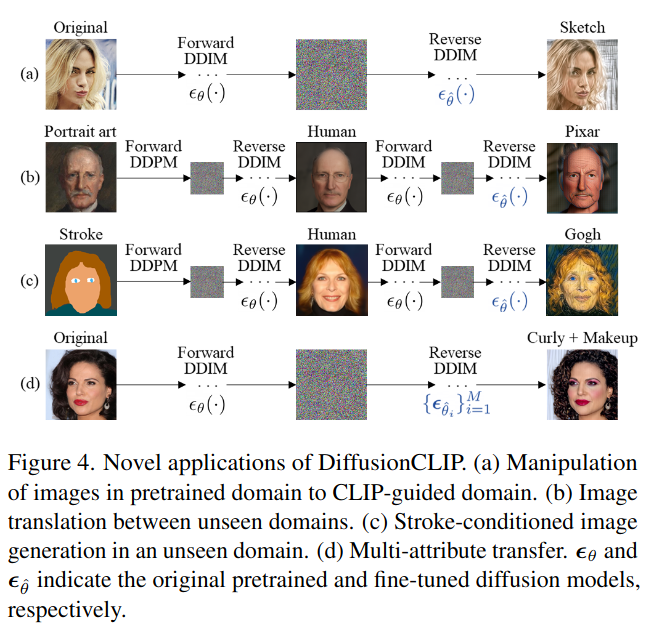
3. 실험
- \(256^2\) size of images
- CelebA-HQ, AFHQ-Dog, LSUN-Bedroom and LSUN-Church로 학습된 각각의 diffusion model을 사용한다.
- \(t_0\): \([300, 600]\)