OOTDiffusion: Outfitting Fusion based Latent Diffusion for Controllable Virtual Try-on
AAAI(2025), 0 citation, Review Data: 2024.3.28
한 줄 요약
Outfitting UNet이 garment feature를 one step으로 학습하고 denoising UNet의 self-attention에서 outfitting fusion으로 합쳐, 명시적 warping 없이 의복 디테일을 보존하는 LDM 기반 virtual try-on.
| 흐름 | 내용 |
|---|---|
| 문제 | 기존 VTON은 독립적인 warping 과정에 크게 의존해 과적합되기 쉽고, CLIP textual-inversion 기반 LDM 방법은 세밀한 garment detail을 보존하지 못한다 |
| 아이디어 | Outfitting UNet + self-attention outfitting fusion으로 garment feature를 target body에 암묵적으로 정렬, outfitting dropout으로 classifier-free guidance 강도 조절 |
| 결과 | VITON-HD, Dress Code에서 정성·정량 비교와 cross-dataset 평가, \(1024 \times 768\) 고해상도 생성 가능 |
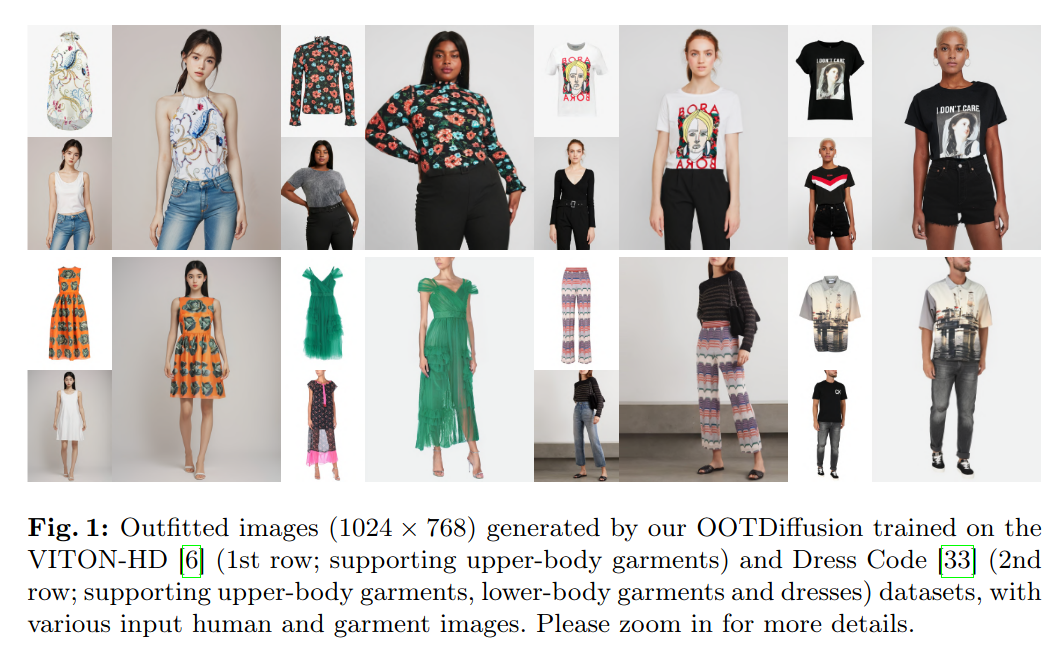
Figure 1. OOTDiffusion 1024×768 생성 결과 (VITON-HD / Dress Code)
1. 문제 정의 — 왜 이 논문이 필요한가
-
현재 image-based VITON 이 직면한 문제는 \(2\) 가지로 볼 수 있다.
- 생성된 이미지는 현실적이고 자연스러워야 하며, 불일치를 피해야 한다. 요즘에는 GAN or LDM 을 활용해서 task 를 수행한다.
- 이전의 GAN-based approach 는 일반적으로 올바른 의복 주름, 자연스러운 빛과 그림자, 또는 현실적인 인체를 생성하는 데 어려움이 존재했다.
- 따라서, 최근의 작업은 LDM 기반의 방법을 선호하며, 이 방법은 착용된 이미지의 현실성을 효과적으로 향상시킨다.
- 복잡한 텍스트, 질감, 색상, 패턴 및 선 등과 같은 의복 세부 특징을 최대한 보존하는 것이다.
- 이전 연구에서는 일반적으로 의복 특징을 대상 인체와 정렬하기 위해 명시적인 변형 과정을 수행하고, 그런 다음 변형된 의복을 생성 모델에 제공했다.
- 따라서 이러한 VTON 방법의 성능은 대개 독립적인 변형 과정의 효과에 극도로 의존하며, 이는 훈련 데이터에 과적합될 수 있다.
- 반면, 일부 LDM-based approach 는 CLIP textual-inversion 을 통해 garment feature 를 학습하고자 했지만 세밀한 garment detail 을 보존하는데 실패했다.
- 생성된 이미지는 현실적이고 자연스러워야 하며, 불일치를 피해야 한다. 요즘에는 GAN or LDM 을 활용해서 task 를 수행한다.
-
OOTDiffusion
- Pretrained latent diffusion models 을 이용하여 UNet 이 garment detail feature 를 학습하게끔 설계했다.
- 중복되는 warping process 없이, 제안된 outfitting fusion 을 통해 UNet 의 self-attention layer 에서 garment feature 가 정확하게 target human body 에 정렬된다.
- 더욱이, classifier-free guidance 를 통해 garment feature 의 strength 를 조절할 수 있도록 outfitting dropout 을 training process 에 도입했다.
- High-resolution image generation 이 가능하다.
2. 사전 지식
- Image-based Virtual Try-on
- GAN-based
- VITON-HD: 고해상도 데이터셋을 수집하고 ALIAS 정규화 및 생성자를 제안하여 변형된 의상과 대상 영역 사이의 불일치를 해결했다.
- HR-VITON: 왜곡 및 segmentation 을 동시에 수행하여 몸의 가려짐과 의상의 불일치를 처리했다.
- GP-VTON: 변형된 의상을 생성하기 위한 LFGP warping module 을 제안하고, warping network 에 대한 DGT 교육 전략을 도입했다.
- GAN-based method 는 일반적으로 실제 의류 주름과 자연스러운 빛과 그림자를 간과하는 명시적인 warping process 에 의존하며, 이는 착용된 이미지의 충실도와 실제감을 심각하게 저하시킨다.
- 또한, 훈련 데이터의 과적합을 유발하고 분포 외 이미지에서 심각한 성능 저하를 초래할 수 있다.
- LDM-based
- LaDI-VTON, DCI-VTON: 명시적인 warping process 를 요구한다.
- 특히 LaDI-VTON 은 시각적 의류 특징을 CLIP token embedding space 에 mapping 하기 위해 textual inversion 을 수행하고, warping 된 입력과 함께 latent diffusion model 을 condition 으로 사용한다.
- DCI-VTON 은 warped cloth 를 masked person image 와 직접 결합하여 coarse result 를 얻은 후, diffusion model 을 통해 정제한다. 이러한 방법 중, 어느 것도 CLIP encoder 에 의한 정보 손실로 인해 복잡한 패턴 및 텍스트와 같은 의복 세부 사항을 완전히 보존하지 못했다.
- StableVITON: 최근에는 해당 model 이 독립적인 warping 을 폐기하고 의복과 인간 몸의 의미적 상관 관계를 학습하기 위한 zero-cross attention block 을 제안했다. 그러나 cross-attention layer 에서 정보 손실이 여전히 발생하며, 추가된 zero block 은 훈련 및 추론 비용을 증가시킨다.
- 반면, 본 논문의 LDM-based OOTDiffusion 은 pre-trained UNet 을 세밀하게 튜닝하여 의복 세부 사항을 one step 에 배우고, 이를 정보 손실이 거의 없는 의복 융합을 한다.
- GAN-based
- LDM-based Controllable Image Generation
- latent diffusion model 은 최근 몇 년간 text-to-image generation 에서 큰 성공을 거뒀다.
- 더 제어 가능한 결과를 위해 prompt-to-prompt 와 Null-text inversion 은 cross-attention layer 를 제어하여 input caption 을 수정하여 모델의 추가적인 훈련없이 이미지를 세밀하게 편집했다.
- InstructPix2Pix: input image 와 text guidance 가 주어졌을 때, 수정된 이미지를 생성하는 diffusion model 을 훈련하기 위해 paired data 를 생성했다.
- Paint-by-example: self-supervised learning 으로 image conditioned diffusion model 을 훈련하여 세밀한 이미지 제어를 제공했다.
- ControlNet, T2I-Adapter: pre-trained diffusion model 에 추가적인 block 을 통합하여 공간 조건부 제어를 가능하게 했다.
- IP-Adapter: text 와 image feature 에 대한 decoupled cross-attention 을 채택하여 image prompt 와 추가적인 구조적 condition 으로 제어 가능한 생성을 가능하게 했다.
- 본 논문에서는 의상 특징에 관련하여 잠재 확산 모델이 더 제어 가능한 착용된 이미지를 생성할 수 있도록, UNet의 self-attention layer 에 outfitting fusion 을 채용하고 훈련 시 outfitting dropout 을 수행했다.
3. 방법
-
Notation
- \(x \in \mathbb{R}^{3 \times H \times W}\): target human image
- \(g \in \mathbb{R}^{3 \times H \times W}\): input garment image
- \(x_g \in \mathbb{R}^{3 \times H \times W}\): generated image
- In this paper, employ OpenPose and HumanParsing model to generate a masked human image
- \(x_m \in \mathbb{R}^{3 \times H \times W}\): masked human image
- VAE Encoder \(\mathcal{E}\): \(\mathcal{E}(x_m) \in \mathbb{R}^{4 \times h \times w}\), where \(h = \frac{H}{8}, w = \frac{W}{8}\)
- \(\epsilon \in \mathbb{R}^{4 \times h \times w}\): Gaussian noise
- \(z_T \in \mathbb{R}^{8 \times h \times w}\): input latent (concatenate \(\epsilon, x_m\))
- \(\mathcal{E}(g) \in \mathbb{R}^{4 \times h \times w}\): encoded garment latent
-
Overview
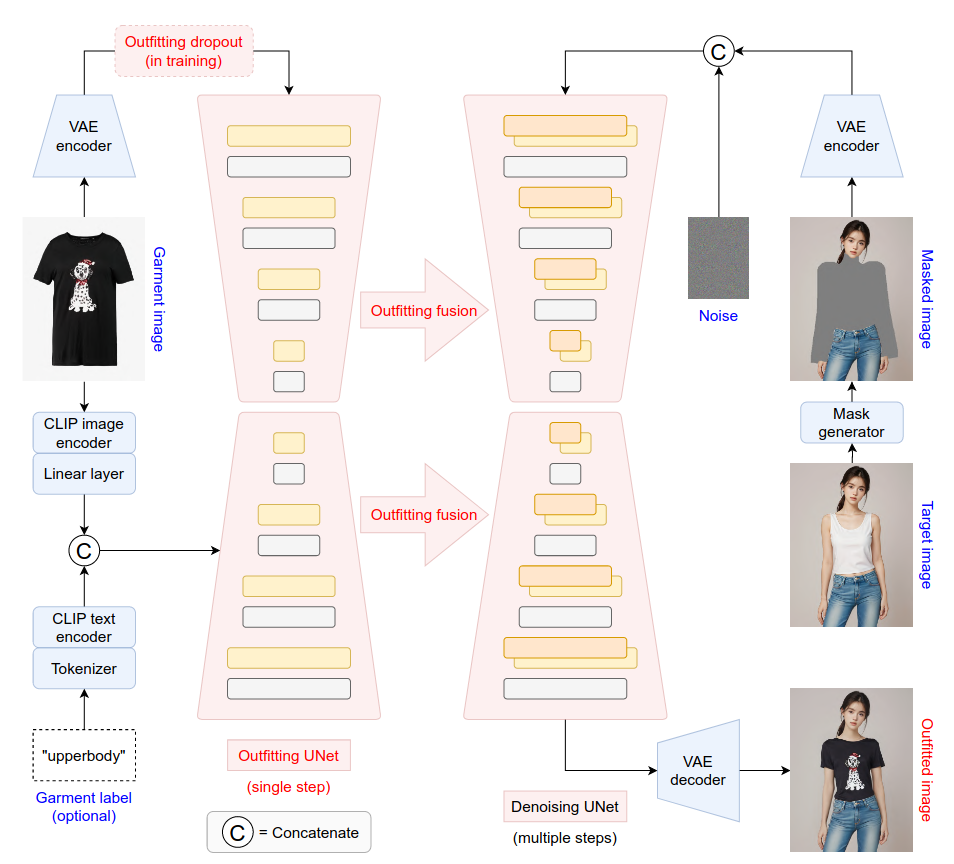
- Concatenate \(\epsilon, x_m\) 해서, \(z_T\) 를 만든다. 따라서 기존의 SD model 에 추가로 \(4\) zero-initialized channel 을 붙인다.
- Encoded garment latent \(\mathcal{E}(g)\) 를 outfitting UNet 에 single step 으로 줘서, garment feature 를 학습하고, 이를 outfitting fusion 을 통해 denoising UNet 에 통합한다.
- 학습 중에, \(\mathcal{E}(g)\) 에 대해서 outfitting dropout 을 수행한다.
- 추가적으로, CLIP textual inversion 을 garment image \(g\) 에 대해서 수행하고, 선택적으로 (optionally) auxiliary conditioning input 으로써 garment label \(y \in\) {upperbody, lowerbody, dress} 에 대한 text embedding 값과 concat 한다. 이는 cross-attention 을 통해 outfitting, denoising UNet 에 모두 적용된다.
- 요약하자면, (1) outfitting UNet 과 denoising Unet 모두 cross-attention 에는 CLIP textual inversion 으로 학습되는 garment image \(g\) 와 option 으로 같이 concat 되는 \(y\) 가 들어가고, (2) one step 으로는 encoded garment latent \(\mathcal{E}(g)\) 가 outfitting UNet 에 들어가서, (3) outfitting fusion 을 통해 denoising UNet 에 통합된다. (4) 그 후, multi-step denoising 으로 noise 제거하고 decoding.
Outfitting UNet
- Stable Diffusion model 의 UNet 과 동일하다. (본 논문에서 제안한 Denoising UNet 과는 다르다. Denoising UNet 은 앞의 conv 에 \(4\) channel 을 추가함)
- \(\omega\): Outfitting UNet
- \(\psi\): garment image 와 text 를 encoding 하고 concat
- 즉, Outfitting UNet 에 condition 과 VAE 로 encoding 한 garment image 를 input 으로 준 결과를 Denoising UNet 에 줘서 동시에 학습한다.
- Outfitting UNet 은 one step forward process 만을 사용한다. Noise 를 추가하지도 않는다. (즉, ControlNet 인데 UNet decoder block 도 사용)

Outfitting Fusion
- Self-attention layer input 으로 \(x_n\) 대신 \(x_{gn}\) 을 사용한다. 그런 다음 출력 특성 맵의 첫 번째 절반을 자르고 이를 self-attention-layer 의 최종 출력으로 사용한다.
- Self-attention layer 에서의 의상 퓨전을 통해 의상 특징이 암묵적으로 warping 되어 target human body 와 무시할 만한 정보 손실로 효과적으로 상관관계를 가진다.
- 따라서 denoising UNet은 outfitting UNet 으로부터 정확한 특성을 학습하여 의복 세부 사항을 보존하고 생성된 이미지에서 대상 인간 몸에 자연스럽게 적응시킨다.
Outfitting Dropout
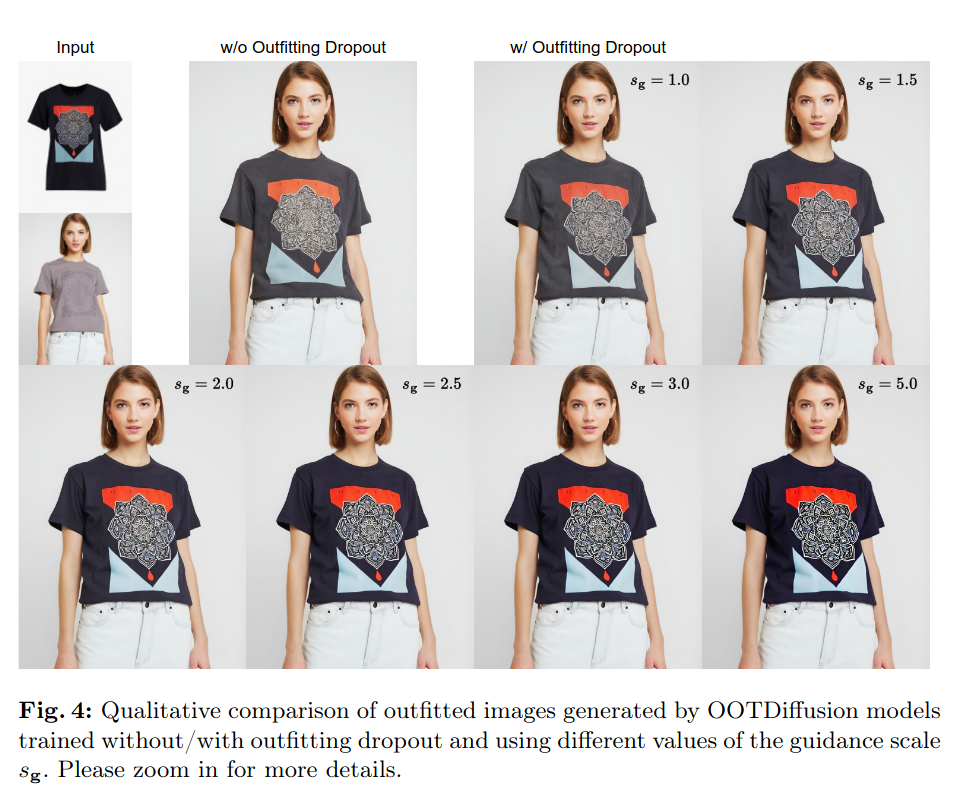
- Classifier-free guidance 를 사용하기 위해, \(\mathcal{E}(g)\) 를 null 로 학습 all-zero latent.
- \(10\) % 비율로 한다.
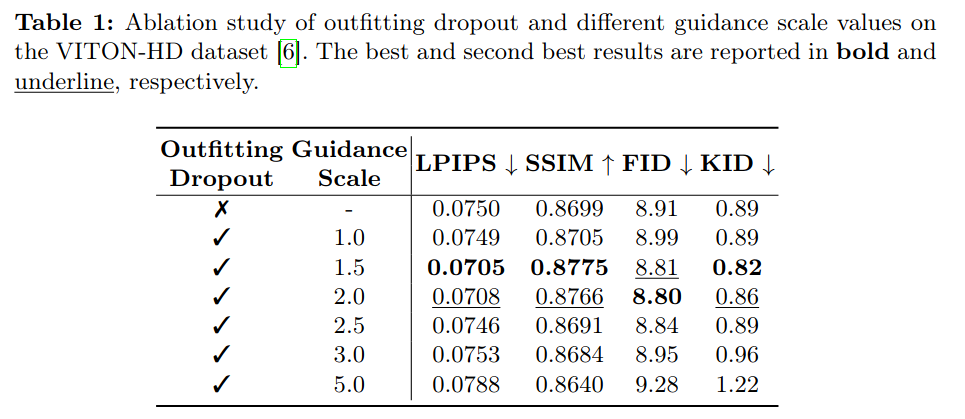
- Guidance scale 은 \(1.5 \sim 2.0\) 이 가장 좋았다.
4. 실험
Dataset
- \(1024 \times 768\) 이미지로 학습가능하지만 \(512 \times 384\) 로 학습 (VITON-HD, DressCode)
- VITON-HD dataset: 13,679 image pairs of frontal half-body models and corresponding upper-body garments, where 2032 pairs are used as the test set.
- Dress Code dataset: 15,363/8,951/2,947 image pairs of full-body models and corresponding upper-body garments/lower-body garments/dresses, where 1,800 pairs for each garment category are used as the test set.
Model
-
VITON-HD dataset (supporting upper-body garments) 과 Dress Code (supporting upper-body, lower-body garments and dresses) dataset 으로 독립적으로 학습된 OOTDiffusion
-
Use Stable Diffusion v1.5
Evaluation
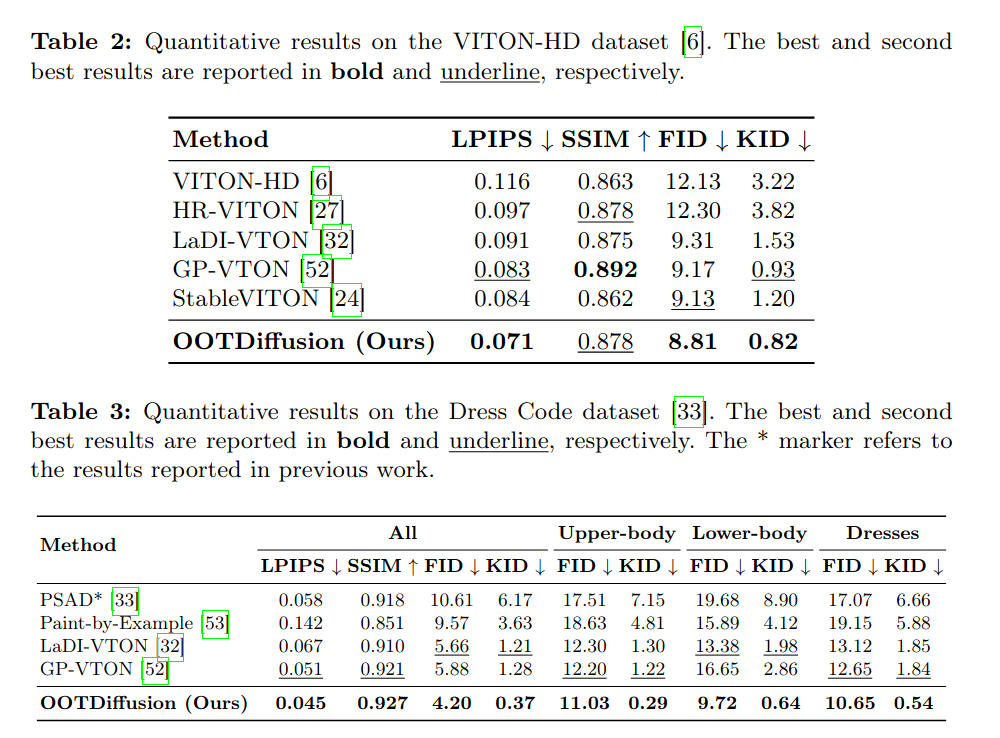
- Paired setting: LPIPS, SSIM
-
Unpaired setting: FID, KID
-
Classifier-free guidance results
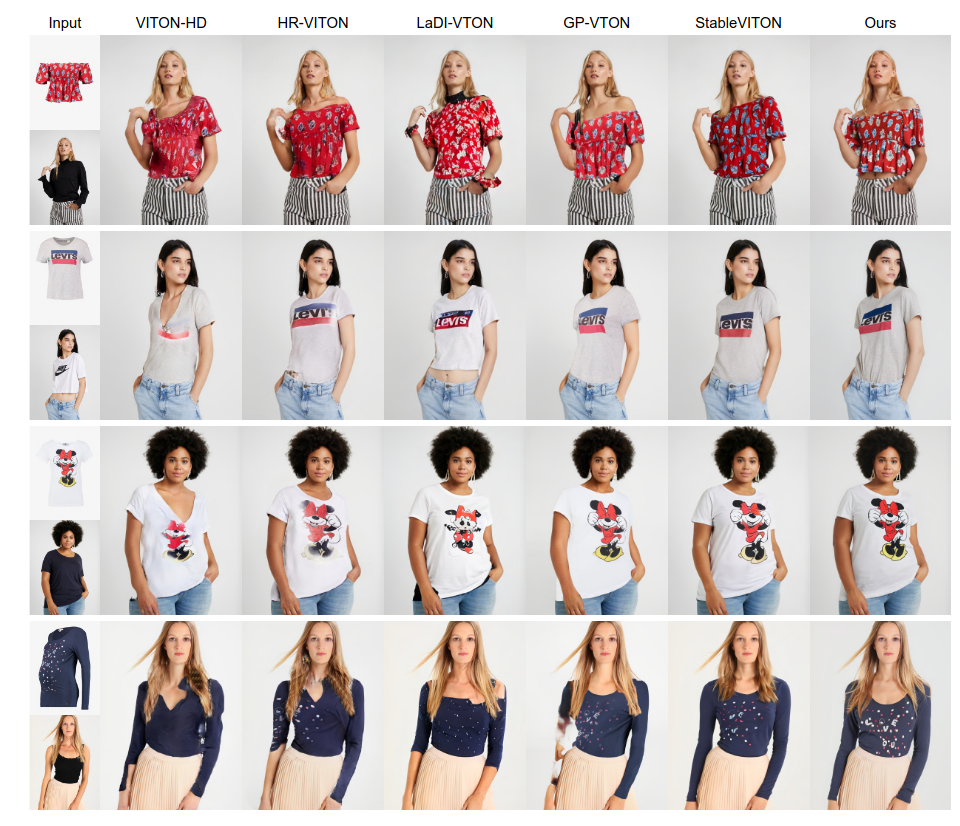
- Qualitative comparison on the VITON-HD
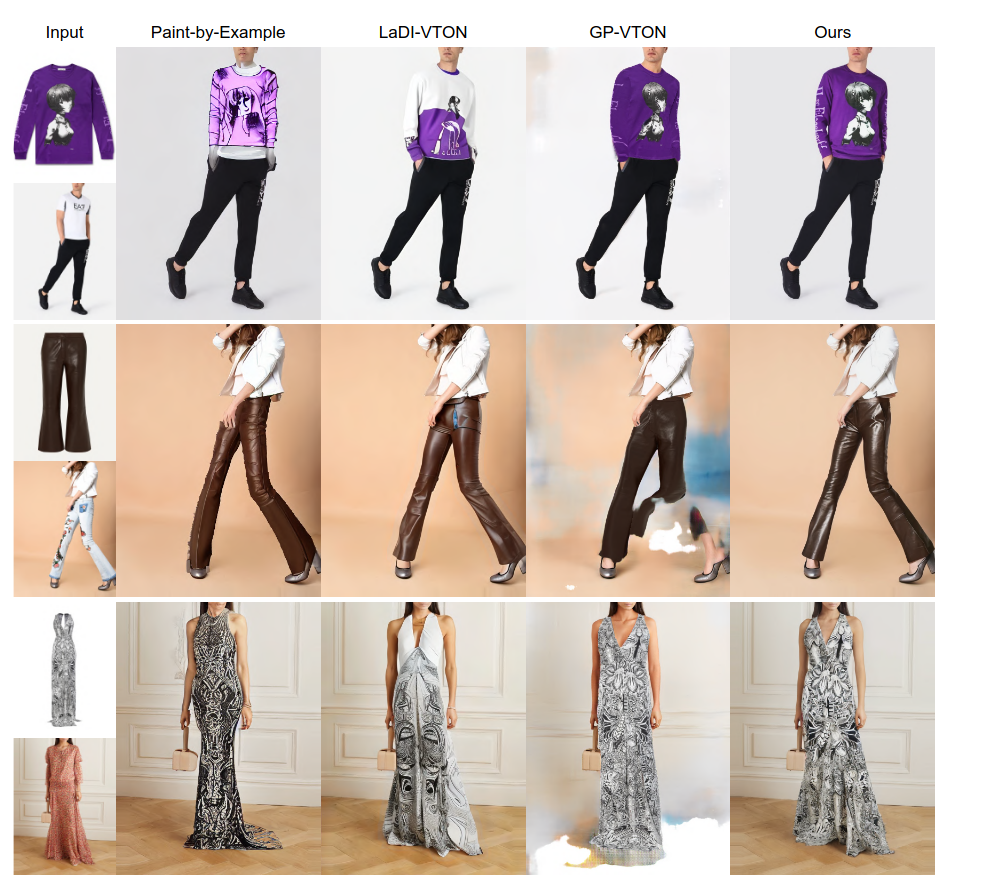
- Qualitative comparison on the DressCode
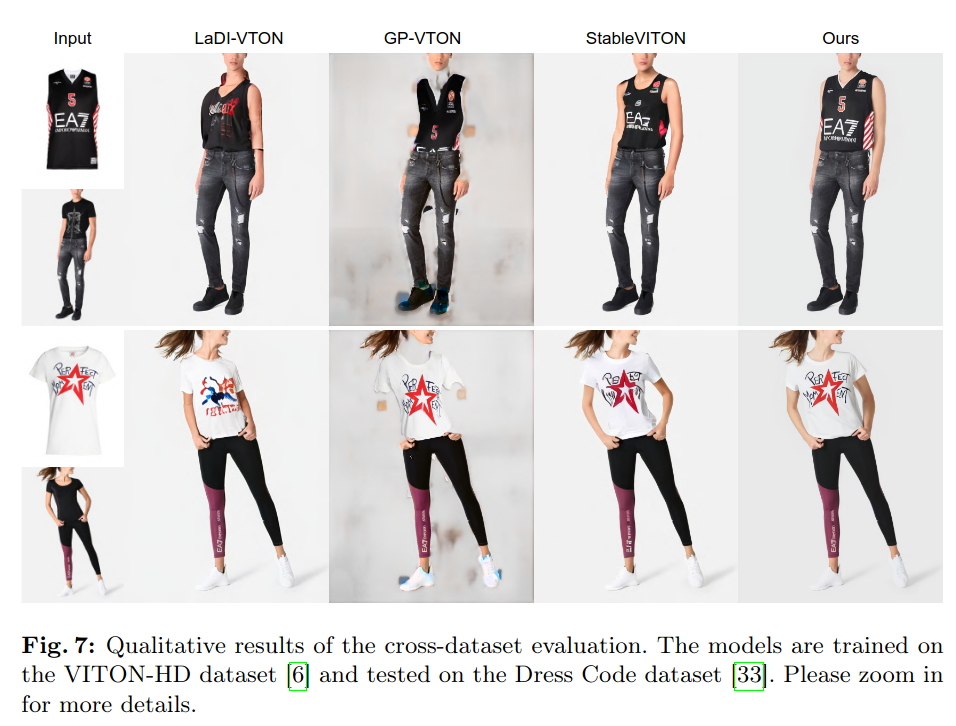
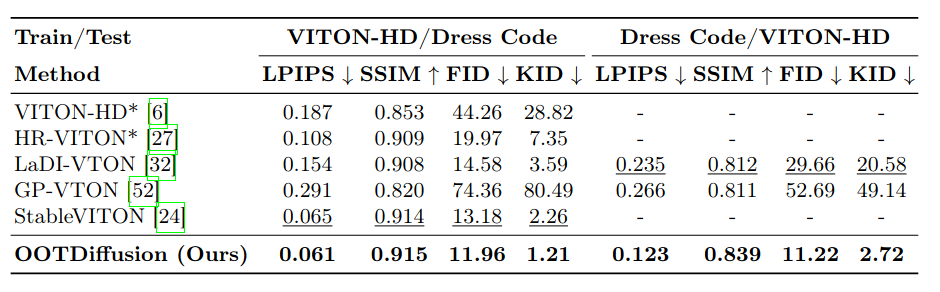
- Cross-dataset evaluation
- Train on the VITON-HD
- test on the DressCode
- Quantitative results
5. 정리
Limitation
- 먼저, 우리의 모델은 짝지어진 인간과 의복 이미지에서 훈련되기 때문에 교차 카테고리 가상 착용에 대해 완벽한 결과를 얻지 못할 수 있습니다. 예를 들어, 긴 드레스를 입은 여성에게 티셔츠를 입히거나 바지를 입은 남성에게 스커트를 입히는 경우 등입니다. 이 문제는 앞으로 동일한 자세에서 다른 옷을 입은 각 사람의 데이터셋을 수집함으로써 부분적으로 해결될 수 있습니다.
- 또 다른 제한 사항은 가상 착용 후 원본 인간 이미지의 일부 세부 사항이 변경될 수 있다는 것입니다. 예를 들어 근육, 시계 또는 타투 등입니다. 그 이유는 관련된 신체 부위가 마스킹되고 확산 모델에 의해 다시 그려지기 때문입니다. 따라서 이러한 문제를 해결하기 위해 더 많은 실용적인 전/후 처리 방법이 필요합니다.