Paint by Example: Exemplar-based Image Editing with Diffusion Models
CVPR(2023), 90 citation
한 줄 요약
Reference image를 CLIP class token 하나로 압축하는 content bottleneck과 strong augmentation, 불규칙 mask로 self-supervised 학습해서, copy-and-paste artifact 없이 exemplar 기반으로 이미지 영역을 편집한다.
Core Idea — "Image Editing with Reference Image using Self-supervised Learning"
| 흐름 | 내용 |
|---|---|
| 문제 | Self-reference setting으로 단순하게 학습하면 model이 reference object를 그대로 copy-and-paste하게 되어 real exemplar에 일반화되지 않는다 |
| 아이디어 | Pre-trained model 초기화 + CLIP global embedding만 쓰는 content bottleneck + strong augmentation(reference image, mask shape) + classifier-free guidance |
| 결과 | Source image와 exemplar를 disentangle/re-organize하여, 임의 모양의 mask 영역에 exemplar를 자연스럽게 합성 |
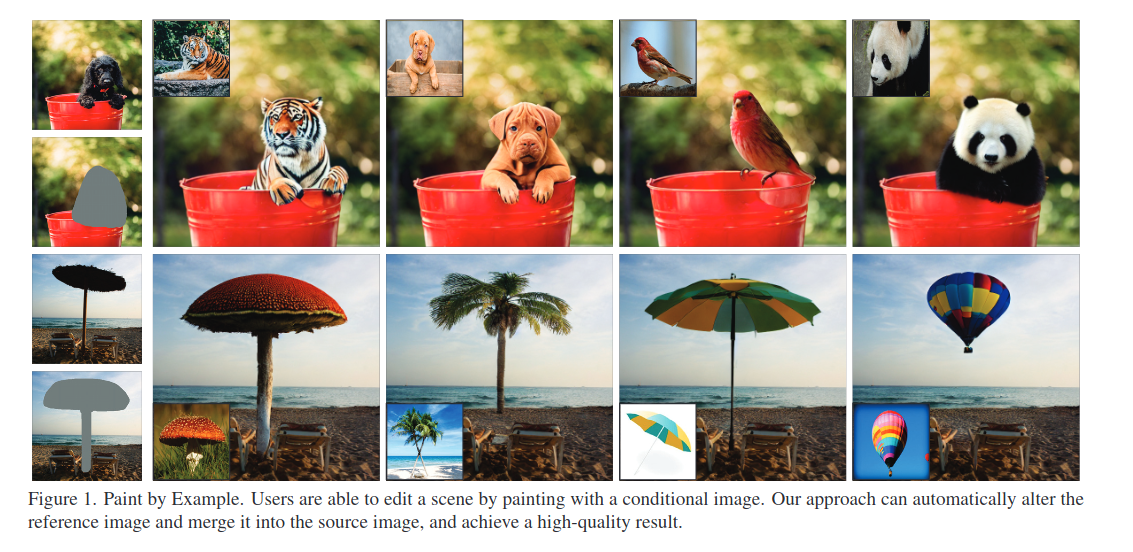
Figure 1. Paint by Example 개요
1. 문제 정의 — 왜 이 논문이 필요한가
- Exemplar-guide 로 image editing 을 진행한다.
- Self-supervised training 으로 source image 와 exemplar 를 disentangle 하고 re-organize 한다.
- 하지만, 단순한 접근 방식으로는 exemplar image 를 copy and paste 하는 것과 같이 명백한 artifacts 를 초래하기에, content bottleneck 과 strong augmentation 을 제안했다.
- Exemplar image 에 대한 arbitrary shape mask 를 설계했고, exemplar image 와의 유사성을 위해 classifier-free guidance 를 도입했다.
- Model 은 self-reference setting 으로 학습된다. (reference image 가 input image 의 변형임)
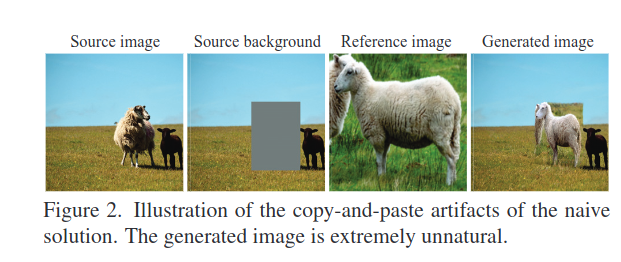
- 하지만 이건, real exemplar 에 일반화되지 않는다. model 은 간단하게 reference object 를 copy-and-paste 하면 되기 때문이다.
- 이 문제를 해결하기 위해 본 논문에서는 \(2\) 가지 방법을 추가로 도입한다.
-
- pre-trained model 사용. 하지만 오랜 시간 fine-tuning 을 하면 문제가 발생할 수 있다.
-
- 따라서, Spatial token 을 버리고 오직 global image embedding 만을 condition 으로 사용하는 self-reference conditioning 을 도입 (content bottleneck)
-
- 더불어서, 훈련이 실제 편집에서 사용되는 것처럼 일반적인 user brush 를 흉내내기 위해 불규칙한 random mask 를 사용했다.
- Classifier-free guidance 를 도입.
- Difficulty
-
- Model 은 reference image 의 형태와 질감을 캡쳐하면서 배경에서의 잡음은 무시해야 한다.
-
- 객체의 변형된 모습 (다른 자세, 크기, 조명) 을 합성하여 원본 이미지에 맞게 표현해야 한다.
-
- Model 은 masking region 의 경계를 smooth 하게 변환시켜야 한다.
-
- Reference image 의 해상도는 edit region 보다 낮을 수 있다. 이런 경우, model 은 super-resolution 을 포함해야 한다.
-
2. 사전 지식
- Image Composition
- Semantic Image Editing
- Text-driven Image Editing
3. 방법
- Source image \(X_s \in R^{H \times W \times 3}\)
- Edit region 은 사각형이나 irregular shape 둘 다 가능
- Binary mask \(m \in\) { \(0,1\) } \(^{H \times W}\)
- \(1\) 이 수정가능한 영역이다.
- Reference image \(X_r \in R^{H' \times W' \times 3}\)
-
우리의 목적은 { \(X_s, X_r, m\) } 으로부터, image \(Y\) 를 생성하는 것이다.
-
Training data
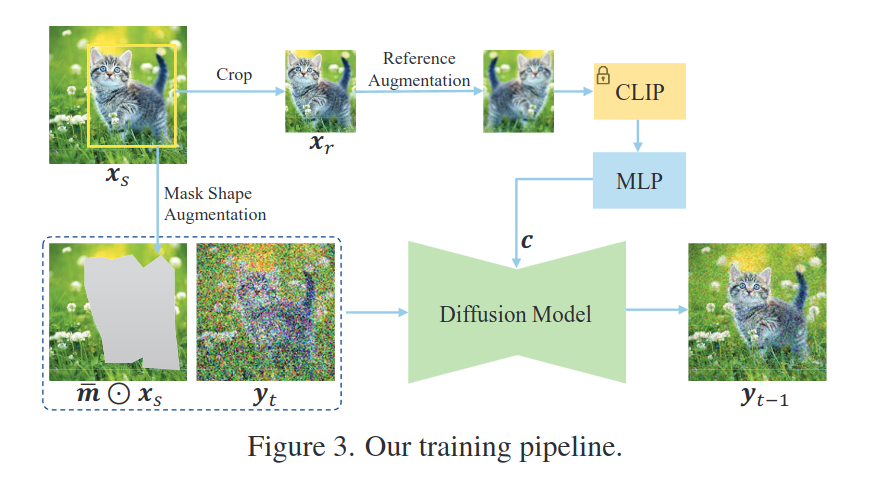
- { \((\bar m \odot X_s, X_r, m),X_s\) }: (원본 이미지에 object 마스킹 된 이미지, 참조 이미지, mask image, ground truth)
- 실제 학습에는 \(m\) 이 들어가지는 않는다.
-
Text-guided inpainting model 의 경우 condition \(c\) 는 text 가 입력으로 들어간 pre-trained CLIP text encoder 의 output (\(77\) token) 이다.
- 마찬가지로, 본 논문에서는 CLIP image embedding 으로 간단하게 생각할 수 있다. (class token \(1\) 개 + patch token \(256\) 개) \(c = CLIP_{all}(X_r)\)
- 이 단순한 해결책은 훈련과정에선 잘 수렴한다. 하지만 test image 에 적용할 때는 생성된 결과가 복사 및 붙여넣기 artifacts 가 존재한다. 즉, 자연스럽지 않은 이미지가 생성된다.
- 따라서, 본 논문에서는 content bottleneck 을 도입하여 네트워크가 단순히 복사하는 것을 막고 reference image 의 contents 를 이해하도록 강제했다.
- 강력한 augmentation 을 도입하여 training 과 test 시의 불일치 문제를 완화한다.
- Classifier-free guidance 도입
-
Compressed representation.
- Text conditioning 의 경우, the model is naturally compelled to learn semantics as text is an intrinsically semantic signal.
- Image conditioning 의 경우, context information 을 이해하기보다는 기억하고 복사하는 것이 쉽기에 model 이 해당 방향으로 나아가게 된다.
- 이를 피하기 위해, reference image 의 정보를 압축하여 mask region 을 재구성하게 하여 난이도를 높여준다. (CLIP image encoder 의 class token 만을 사용)
- 이로써, reference image 를 \(224 \times 224 \times 3\) 에서 차원이 \(1024\) 인 \(1\) 차원 벡터로 압축하게 된다.
- 하지만, 이렇게 고도로 압축하게 되면 의미 정보는 유지하지만 high-frequency detail 을 무시하는 경향이 있어서 FC layer 를 추가로 연결하여 feature 를 decode 한다.
- 또한, 복사 붙여넣기 학습을 방지하기 위해 pre-trained model 을 사용한다. (좋은 초기화)
-
Strong Augmentation. (\(A\))
- Self-supervised learning 으로 인해, training & testing 사이의 domain gap 이 존재한다.
- 따라서, Augmentation 을 진행 (including flip, rotation, blur and elastic transform) 하여 source image 와의 연결을 끊는다.
Important
Condition
-
Mask Shape Augmentation.
- Bounding box 에 기반한 arbitrarily shaped mask 를 생성했다.
-
- Bounding box 의 edge 에 대해, 먼저 Bessel curve 를 만들고 curve 에서 uniformly \(20\) 개의 point 를 sampling.
-
- 무작위로 \(1 - 5\) pixel offset 을 추가한다.
-
- 이러한 지점들을 직선으로 순차적으로 연결하여 임의의 모양을 가진 mask 를 생성한다.
- Training 과 Test 시에 차이를 줄였다.
-
Classifier-free guidance
- \(20\) % 로 learnable vector \(v\) 를 사용
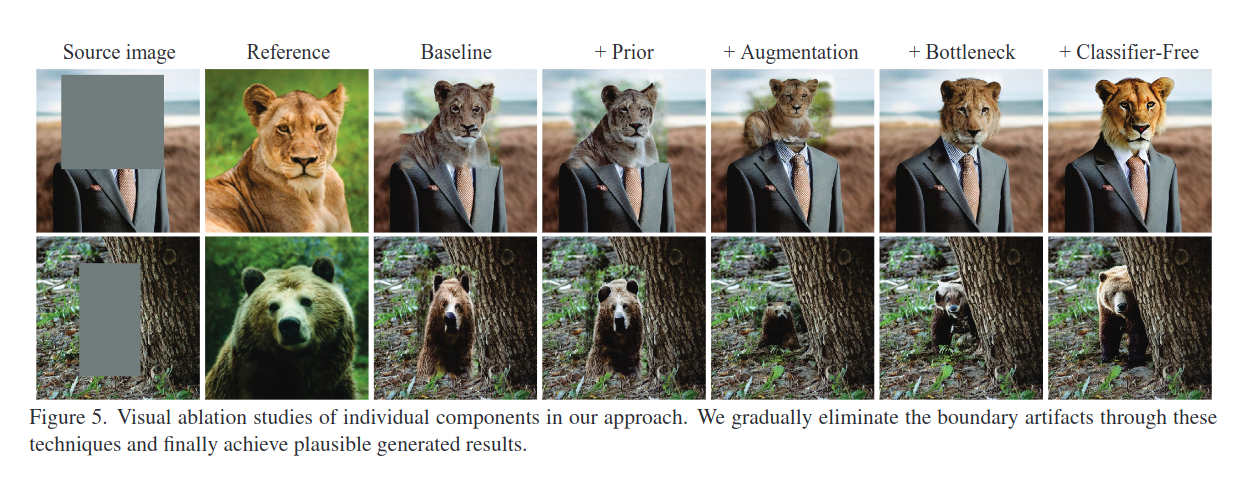
- Ablation study
- Baseline: pre-trained model 안 쓰고 학습
- Prior: pre-trained model 사용
- Augmentation: strong augmentation
- Bottleneck: class token 만 사용
4. 정리
-
Self-supervised Learning 으로 인해 reference image 가 학습 과정에서 올바르게 작동하지 않을 수 있다. (copy-and-paste)
-
pre-trained model 사용. 하지만 오랜 시간 fine-tuning 을 하면 문제가 발생할 수 있다.
-
CLIP image embedding 의 Spatial token 을 버리고 오직 global image embedding 만을 condition 으로 사용하는 self-reference conditioning 을 도입 (content bottleneck)
- 이렇게 함으로써, 강제적으로 reference image 의 contents 를 이해하도록 시킴 (정보가 적으니까)
-
훈련이 실제 편집에서 사용되는 것처럼 일반적인 user brush 를 흉내내기 위해 불규칙한 random mask 를 사용했다.
-
Strong Augmentation
- Reference image
- Mask shape
-
Classifier-free guidance 를 도입.